GATE Engineering Sciences Syllabus 2027: Complete XE Syllabus and Topics
GATE Engineering Sciences Syllabus 2027
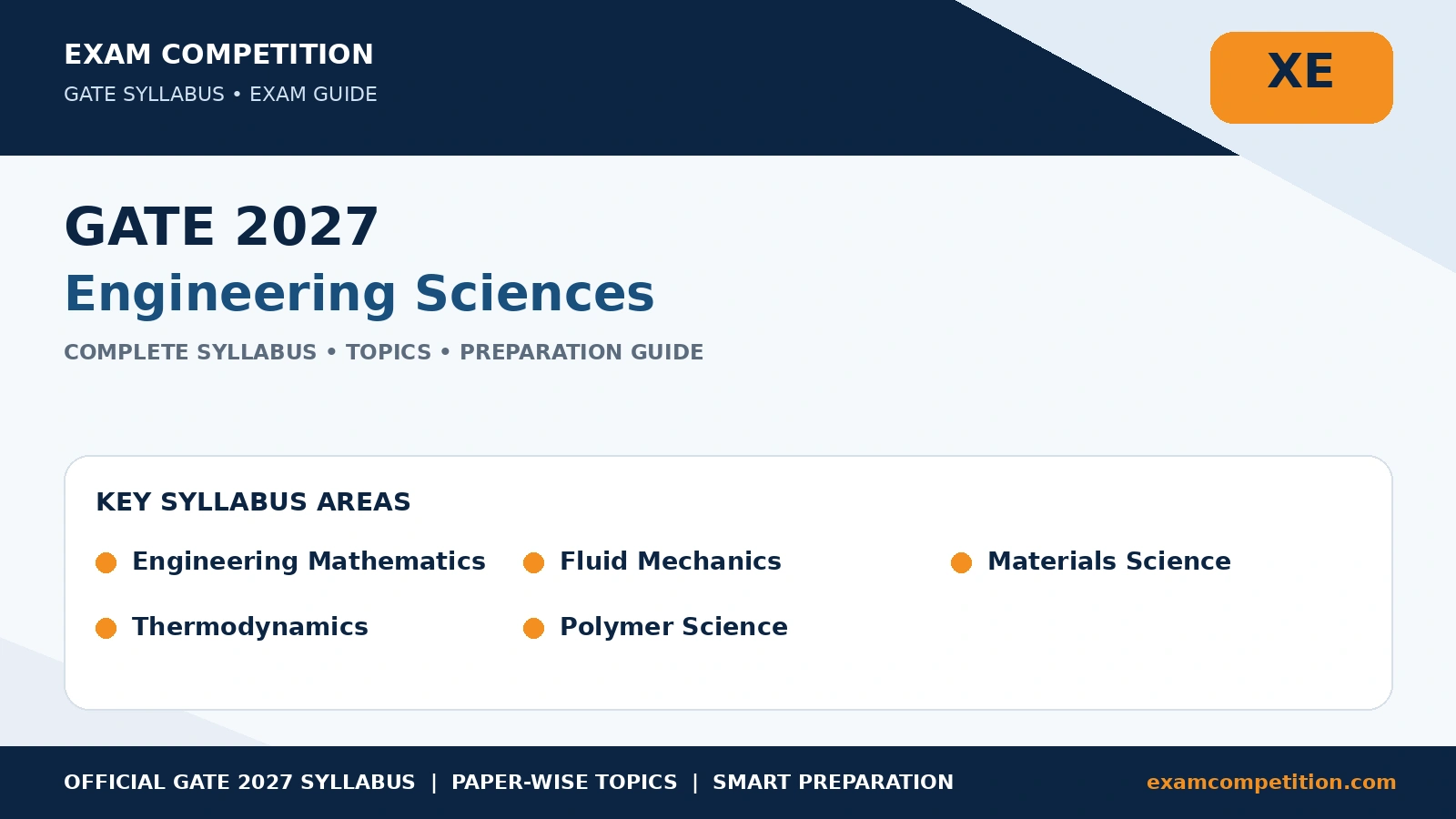
The GATE Engineering Sciences (XE) paper is a sectional paper designed for candidates from different engineering and science backgrounds. The official IIT Madras syllabus consists of a compulsory XE0: Engineering Mathematics section and nine optional sections.
Every XE candidate has to attempt the common Engineering Mathematics section and then select any two optional sections from the available choices. The optional sections cover Fluid Mechanics, Materials Science, Solid Mechanics, Thermodynamics, Polymer Science and Engineering, Food Technology, Atmospheric and Oceanic Sciences, Energy Science, and Textile Engineering and Fibre Science.
GATE XE Syllabus at a Glance
| Code | Section | Status | Major Areas |
|---|---|---|---|
| XE0 | Engineering Mathematics | Common | Linear Algebra, Calculus, Vector Calculus, Complex Variables, Ordinary Differential Equations, Partial Differential Equations, Probability and Statistics, Numerical Methods |
| XE1 | Fluid Mechanics | Optional | Flow Classification, Hydrostatics, Fluid Kinematics, Control Volume Analysis, Navier-Stokes Equations, Dimensional Analysis, Internal and External Flows |
| XE2 | Materials Science | Optional | Materials Structure, Thermodynamics, Kinetics, Phase Transformations, Properties, Characterization, Processing and Degradation |
| XE3 | Solid Mechanics | Optional | Rigid Bodies, Deformable Bodies, Stress and Strain, Failure Theories, Beam Analysis, Torsion, Buckling and Vibrations |
| XE4 | Thermodynamics | Optional | Basic Concepts, Pure Substances, First and Second Laws, Entropy, Thermodynamic Relations, Cycles and Gas Mixtures |
| XE5 | Polymer Science and Engineering | Optional | Polymer Chemistry, Characterization, Manufacturing, Properties, Blends, Additives, Rheology, Processing, Testing and Recycling |
| XE6 | Food Technology | Optional | Food Chemistry, Nutrition, Microbiology, Food Processing, Food Engineering, Packaging, Quality and Food Safety |
| XE7 | Atmospheric and Oceanic Sciences | Optional | Atmospheric Science, Ocean Sciences, Radiation, Atmospheric Dynamics, Monsoons, Ocean Circulation, Tides, Waves and Biogeochemical Processes |
| XE8 | Energy Science | Optional | Energy Resources, Energy Conversion, Solar Energy, Wind Energy, Biomass, Hydrogen, Fuel Cells, Batteries and Energy Storage |
| XE9 | Textile Engineering and Fibre Science | Optional | Textile Fibres, Yarn Manufacturing, Fabric Manufacturing, Textile Chemical Processing, Testing and Garment Manufacturing |
GATE XE Exam Pattern
The GATE XE paper has a total of 100 marks and a duration of 180 minutes. General Aptitude contributes 15 marks. The XE paper then contains 15 marks from the common Engineering Mathematics section and two selected optional sections carrying 35 marks each.
| Component | Marks |
|---|---|
| General Aptitude | 15 |
| XE0: Engineering Mathematics | 15 |
| First Selected Optional Section | 35 |
| Second Selected Optional Section | 35 |
| Total | 100 |
| Duration | 180 minutes |
XE0: Engineering Mathematics
Engineering Mathematics is compulsory for all XE candidates. The official syllabus contains eight sections covering the mathematical tools required for the different Engineering Sciences options.
XE0.1: Linear Algebra
- Algebra of real matrices
- Determinant
- Inverse and rank of a matrix
- Systems of linear equations
- Conditions for unique, no and infinitely many solutions
- Eigenvalues and eigenvectors
- Properties of eigenvalues and eigenvectors of symmetric matrices
- Diagonalization
- Cayley-Hamilton theorem
XE0.2: Calculus
| Area | Topics |
|---|---|
| Single Variable | Limits, indeterminate forms, L'Hospital's rule, continuity, differentiability, mean value theorems, maxima and minima, Taylor's theorem and integral calculus |
| Integration | Definite and improper integrals and applications to areas and volumes |
| Two Variables | Limits, continuity, partial derivatives, directional derivatives and total derivatives |
| Optimization | Maxima, minima, saddle points and Lagrange multipliers |
| Multiple Integrals | Double integrals and applications |
| Sequences and Series | Convergence, convergence tests, power series and Taylor series |
XE0.3: Vector Calculus
- Gradient
- Divergence
- Curl
- Line integrals
- Green's theorem
XE0.4: Complex Variables
- Complex numbers
- Argand plane
- Polar representation of complex numbers
- De Moivre's theorem
- Analytic functions
- Cauchy-Riemann equations
XE0.5: Ordinary Differential Equations
- First-order linear and nonlinear equations
- Second-order linear differential equations with constant coefficients
- Cauchy-Euler equation
- Second-order equations with variable coefficients
- Wronskian
- Variation of parameters
- Eigenvalue problems for second-order equations
- Power series solutions for ordinary points
XE0.6: Partial Differential Equations
- Classification of second-order linear partial differential equations
- One-dimensional heat equation
- One-dimensional wave equation
- Two-dimensional Laplace equation
- Method of separation of variables
- Fourier series method
XE0.7: Probability and Statistics
- Axioms of probability
- Conditional probability
- Total probability theorem
- Bayes' theorem
- Mean, variance and standard deviation of random variables
- Binomial distribution
- Poisson distribution
- Normal distribution
- Correlation
- Linear regression
XE0.8: Numerical Methods
- LU decomposition
- Gauss elimination method
- Lagrange interpolation
- Newton interpolation
- Bisection method
- Newton-Raphson method
- Trapezoidal rule
- Simpson's 1/3rd rule
- Simpson's 3/8th rule
- Euler's method for first-order differential equations
XE1: Fluid Mechanics
| Section | Topics |
|---|---|
| Classification of Flows | Fluid concept, viscosity, Newtonian and non-Newtonian fluids, incompressible and compressible flows, internal and external flows, steady and unsteady flows, laminar and turbulent flows |
| Hydrostatics | Buoyancy, manometry, forces on submerged bodies and stability |
| Fluid Kinematics | Eulerian and Lagrangian descriptions, local, convective and material derivatives, streamlines, streaklines and pathlines |
| Control Volume | Reynolds Transport Theorem and conservation of mass and linear momentum |
| Differential Analysis | Continuity and momentum equations, Euler equation, Bernoulli equation, Navier-Stokes equation, Couette flow, Poiseuille flow, vorticity, stream function and circulation |
| Dimensional Analysis | Similarity, Buckingham Pi theorem, Reynolds number, Froude number and Mach number |
| Internal Flows | Fully developed pipe flow, friction factor, Darcy-Weisbach relation, Moody's chart, major and minor losses |
| Potential Flows | Velocity potential, uniform flow, source, sink and vortex |
| External Flows | Prandtl boundary layer, boundary layer thickness, displacement thickness, momentum thickness, separation, drag and lift |
XE2: Materials Science
Materials Science covers the structure, thermodynamics, properties, characterization, processing and degradation of engineering materials.
| Section | Major Topics |
|---|---|
| Classification and Structure | Metals, ceramics, polymers, composites, crystallography, crystal systems, Bravais lattices, Miller indices, close-packed structures, carbon structures, compounds, amorphous materials, solid solutions, polymers and crystal defects |
| Thermodynamics and Phase Transformations | Thermodynamic properties, phase equilibria, phase diagrams, reaction kinetics, diffusion, solidification, nucleation, growth, precipitation, eutectoid transformation, TTT and CCT diagrams, martensitic transformation and glass transition |
| Properties and Applications | Mechanical, electronic, magnetic, thermal and optical properties of materials, composites, semiconductors, dielectric materials and magnetic materials |
| Characterization | X-ray diffraction, UV-Vis, IR and Raman spectroscopy, microscopy, energy dispersive spectroscopy, tensile testing, hardness, electrical conductivity and thermal analysis |
| Processing | Heat treatment of steels and aluminium alloys, silicon processing, zone refining, crystal growth, oxidation, doping, photolithography, powder preparation and sintering |
| Degradation | Electrochemical corrosion, standard electrode potential, galvanic series, Nernst equation, polarization, passivation, corrosion forms and prevention, polymer degradation and weathering |
XE3: Solid Mechanics
XE3.1: Mechanics of Rigid Bodies
- Equivalent forces and moments
- Equilibrium equations
- Determinate trusses and frames
- Sliding and sticking friction
- Principle of minimum potential energy
- Particle kinematics and dynamics
- Interconnected and constrained rigid bodies in planar motion
- Conservation of energy and momentum
XE3.2: Mechanics of Deformable Bodies
| Area | Topics |
|---|---|
| Stress and Strain | Stress, strain, transformation of stresses and strains, principal stresses and Mohr's circle |
| Elasticity | Elastic constants, generalized Hooke's law and thermal stresses |
| Failure | von Mises, Tresca and maximum principal stress theories |
| Beam Analysis | Axial force, shear force, bending moment, stresses and deflection |
| Energy Methods | Castigliano's theorems |
| Torsion | Torsion of circular shafts |
| Buckling | Euler buckling |
| Pressure Vessels | Thin-walled pressure vessels |
XE3.3: Vibrations
- Free vibration of single-degree-of-freedom systems
- Forced vibration of single-degree-of-freedom systems
- Effect of damping
- Base excitation
XE4: Thermodynamics
| Section | Major Topics |
|---|---|
| Basic Concepts | Continuum, microscopic and macroscopic approaches, thermodynamic systems, properties, state, equilibrium, processes, heat, work and Zeroth Law |
| Pure Substances | Solid, liquid and vapor phases, P-v-T behaviour, triple point, critical point, ideal gases and real gases |
| First Law | Energy, internal energy, enthalpy, specific heats, closed systems, control volumes and steady-flow energy equation |
| Second Law | Heat engines, heat pumps, refrigerators, efficiency, COP, Kelvin-Planck and Clausius statements, reversible processes and Carnot principles |
| Entropy | Clausius inequality, entropy generation, increase of entropy, T-s diagrams, isentropic processes and second-law efficiency |
| Thermodynamic Relations | T-ds relations, Helmholtz and Gibbs functions, Gibbs relations, Maxwell relations, Joule-Thomson coefficient, compressibilities and Clapeyron equations |
| Thermodynamic Cycles | Carnot vapor cycle, Rankine cycle, vapor-compression refrigeration, Otto, Diesel and Brayton cycles |
| Ideal Gas Mixtures | Dalton's and Amagat's laws, ideal gas mixtures, air-water vapor mixtures, humidity, dew point and psychrometric processes |
XE5: Polymer Science and Engineering
| Section | Major Topics |
|---|---|
| Polymer Chemistry | Monomers, degree of polymerization, polymer classification, addition and condensation polymerization, copolymerization and polymerization techniques |
| Polymer Characterization | Solubility, swelling, molecular weight distribution, molecular weights, glass transition, melting transition, crystallinity, IR, XRD, DSC, DMTA, TGA, microscopy and GPC |
| Synthesis, Manufacturing and Properties | Thermoplastics, polyesters, acrylics, polyurethane, engineering plastics, thermosets, rubbers, specialty plastics and biodegradable polymers |
| Blends and Composites | Polymer blends, miscibility, phase morphology, polymer alloys, eutectics and fibre-reinforced composites |
| Additives and Compounding | Crosslinkers, antioxidants, stabilizers, lubricants, processing aids, impact modifiers, flame retardants, antistatic agents, carbon black, mixing and vulcanization |
| Polymer Rheology | Newtonian and non-Newtonian flow, rheological measurements, viscoelasticity, creep, stress relaxation, dynamic testing and mechanical models |
| Polymer Processing | Spin coating, electrospinning, solution and melt spinning, compression molding, injection molding, extrusion, calendaring, thermoforming and rubber processing |
| Polymer Testing | Mechanical, electrical, thermal, optical and environmental testing of polymers |
| Recycling and Sustainability | Polymer waste, identification and separation, mechanical and chemical recycling, life-cycle assessment, biodegradable polymers and microplastics |
XE6: Food Technology
| Section | Major Topics |
|---|---|
| Food Chemistry and Nutrition | Carbohydrates, proteins, lipids, pigments, flavours, enzymes, nutrition, vitamins, minerals, nutraceuticals, adulteration and processing-related chemical changes |
| Food Microbiology | Microorganisms, microbial growth, D-value, Z-value, F-value, spoilage, pathogens, toxins, fermented foods, probiotics, prebiotics and synbiotics |
| Food Products Technology | Thermal and non-thermal processing, packaging, storage, cereal processing, oil processing, fruits and vegetables, dairy, meat, fish, plantation crops and waste utilization |
| Food Engineering | Mass and energy balances, momentum transfer, heat transfer, mass transfer, mechanical operations, thermal operations, drying, freezing and crystallization |
| Quality and Food Safety | Food standards, HACCP, sanitation, FSSAI, BIS, Codex Alimentarius, ISO and Food Safety Management Systems |
XE7: Atmospheric and Oceanic Sciences
Atmospheric Science
- Vertical structure and composition of the atmosphere
- Blackbody radiation and radiation balance
- Modes of heat transfer
- Greenhouse effect
- Cloud types
- Thermodynamic and gas laws
- Hydrostatic equation
- Clausius-Clapeyron equation
- Adiabatic processes
- Humidity and atmospheric stability
- Global radiation budget
- Navier-Stokes and continuity equations
- Pressure-gradient, Coriolis, centripetal and centrifugal forces
- Geostrophic, gradient and cyclostrophic balances
- Circulation and vorticity
- General circulation of the atmosphere
- Broad features of Indian monsoons
- Fundamentals of tropical cyclones
Ocean Sciences
- Vertical profiles of temperature and salinity
- Stability and double diffusion
- Equation of state
- Conservation of mass, momentum, heat and salt
- Inertial currents
- Geostrophic motion
- Air-sea surface fluxes
- Wind-driven circulation
- Ekman and Sverdrup transports
- Storm surges
- Tides and tsunamis
- Wind waves
- Eddies and gyres
- Thermohaline circulation
- Chemical properties of seawater
- Ocean acidification
- Biogeochemical cycling
XE8: Energy Science
Energy Science is one of the optional XE sections. Candidates selecting this section should prepare the fundamentals of energy resources, energy conversion technologies and modern energy systems.
| Preparation Area | Focus |
|---|---|
| Energy Resources | Conventional and renewable energy resources |
| Energy Conversion | Principles and performance of energy conversion systems |
| Solar Energy | Solar energy conversion and related technologies |
| Wind Energy | Wind energy resources and conversion systems |
| Biomass | Biomass resources and energy conversion |
| Hydrogen | Hydrogen production, storage and utilization |
| Fuel Cells | Fuel-cell principles and applications |
| Energy Storage | Battery and other energy-storage technologies |
XE9: Textile Engineering and Fibre Science
| Preparation Area | Major Topics |
|---|---|
| Textile Fibres | Natural and synthetic fibres, fibre properties and fibre science |
| Yarn Manufacturing | Principles and processes used for yarn production |
| Fabric Manufacturing | Methods and principles of fabric formation |
| Textile Chemical Processing | Textile chemical processing and finishing |
| Textile Testing | Testing and evaluation of textile materials |
| Garment Manufacturing | Fundamentals of garment manufacturing and related operations |
How to Choose GATE XE Optional Sections
The choice of optional sections is one of the most important decisions for XE candidates. Since the examination requires two optional sections, candidates should select subjects that match their academic background, preparation level and target postgraduate programme.
| Optional Section | Suitable Backgrounds |
|---|---|
| XE1: Fluid Mechanics | Mechanical, Civil, Aerospace and related engineering backgrounds |
| XE2: Materials Science | Materials, Metallurgical, Mechanical, Chemical and related backgrounds |
| XE3: Solid Mechanics | Mechanical, Civil, Aerospace and structural engineering backgrounds |
| XE4: Thermodynamics | Mechanical, Chemical, Energy and related engineering backgrounds |
| XE5: Polymer Science and Engineering | Polymer, Chemical, Materials and related backgrounds |
| XE6: Food Technology | Food Technology, Food Engineering and related science backgrounds |
| XE7: Atmospheric and Oceanic Sciences | Earth, atmospheric, oceanic, environmental and related science backgrounds |
| XE8: Energy Science | Energy, Mechanical, Electrical, Chemical and related engineering backgrounds |
| XE9: Textile Engineering and Fibre Science | Textile, Fibre and related engineering backgrounds |
Important GATE XE Preparation Topics
| Section | Key Focus Areas |
|---|---|
| XE0 Engineering Mathematics | Linear algebra, calculus, vector calculus, complex variables, differential equations, PDEs, probability, statistics and numerical methods |
| XE1 Fluid Mechanics | Fluid properties, hydrostatics, continuity, momentum, Bernoulli equation, Navier-Stokes equations, dimensional analysis, pipe flow and boundary layers |
| XE2 Materials Science | Crystallography, phase transformations, diffusion, mechanical properties, electronic properties, characterization, processing and corrosion |
| XE3 Solid Mechanics | Statics, rigid body mechanics, stress-strain analysis, failure theories, beams, torsion, buckling and vibrations |
| XE4 Thermodynamics | Thermodynamic laws, properties, entropy, thermodynamic relations, cycles, refrigeration and gas mixtures |
| XE5 Polymer Science | Polymer chemistry, characterization, processing, rheology, composites, testing and recycling |
| XE6 Food Technology | Food chemistry, nutrition, microbiology, processing, packaging, food engineering and food safety |
| XE7 Atmospheric and Oceanic Sciences | Atmospheric structure, radiation, dynamics, monsoons, ocean circulation, tides, waves and ocean chemistry |
| XE8 Energy Science | Energy resources, conversion systems, renewable energy, hydrogen, fuel cells and energy storage |
| XE9 Textile Engineering and Fibre Science | Fibres, yarns, fabrics, textile processing, testing and garment manufacturing |
How to Prepare for GATE Engineering Sciences
XE preparation should begin with the compulsory Engineering Mathematics section. Candidates should build confidence in linear algebra, calculus, differential equations, probability and numerical methods because these topics form the common mathematical foundation of the paper.
The next step is to select two optional sections. Candidates should not select options simply because they appear popular. The better approach is to compare the official syllabus with the candidate's academic background, existing preparation and preferred postgraduate programmes.
Once the two optional sections are selected, candidates should avoid repeatedly changing their choices. Each optional section contains a substantial syllabus, and consistent preparation is important for completing both sections thoroughly.
Numerical practice is particularly important for Fluid Mechanics, Solid Mechanics, Thermodynamics and Engineering Mathematics. Materials Science, Polymer Science, Food Technology, Atmospheric and Oceanic Sciences, Energy Science and Textile Engineering may require a combination of conceptual understanding, factual recall and numerical application depending on the topic.
Candidates should create separate formula and concept notes for XE0 and each selected optional section. Previous GATE questions and timed mock tests should be used after completing the core syllabus to improve accuracy and time management.
GATE Engineering Sciences Syllabus PDF
The official IIT Madras combined syllabus PDF contains XE0 Engineering Mathematics and all nine optional Engineering Sciences sections. Candidates should use the official document as the primary reference while preparing for the examination.
Download GATE Engineering Sciences Syllabus PDF
Frequently Asked Questions
What is the GATE XE paper?
How many sections are there in GATE XE?
How many optional sections can I choose in GATE XE?
Is Engineering Mathematics compulsory in GATE XE?
How many marks are the two optional XE sections worth?
What optional sections are available in GATE XE?
Can I change my optional XE sections during the examination?
What is the total duration of the GATE XE paper?
Which section should I choose in GATE XE?
Source: IIT Madras