GATE Humanities and Social Sciences Syllabus 2027: Complete XH Syllabus and Topics
GATE Humanities and Social Sciences Syllabus 2027
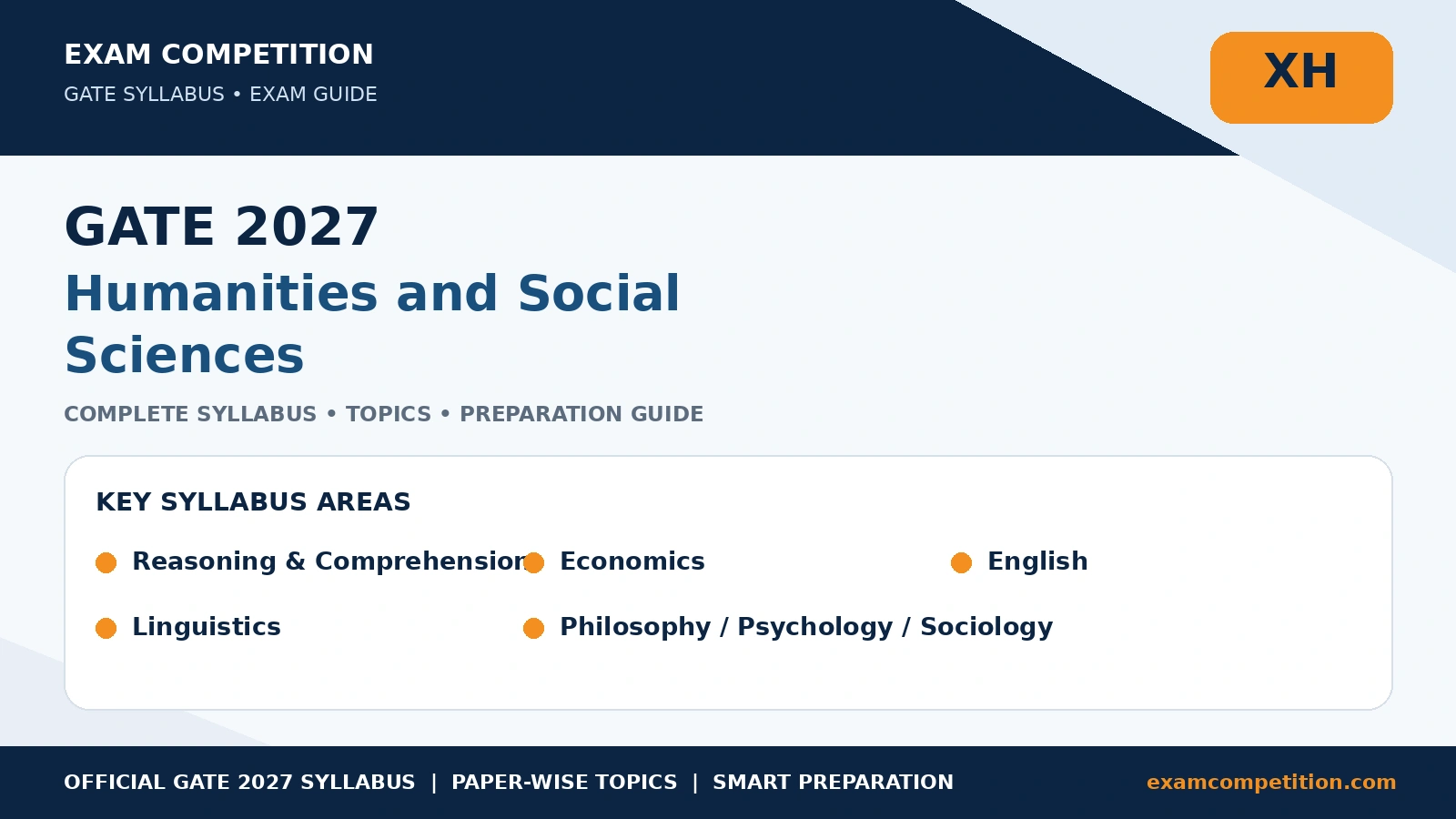
The GATE Humanities and Social Sciences (XH) paper is designed for candidates interested in postgraduate and doctoral opportunities in humanities and social science disciplines. The official IIT Madras syllabus contains a compulsory XH0: Reasoning and Comprehension section and six optional subject sections.
Every XH candidate must attempt the common Reasoning and Comprehension section and select one optional section at the time of application. The available optional subjects are Economics, English, Linguistics, Philosophy, Psychology and Sociology.
GATE XH Syllabus at a Glance
| Code | Section | Status | Major Areas |
|---|---|---|---|
| XH0 | Reasoning and Comprehension | Common for all XH candidates | Reading Comprehension, Expression, Analytical Reasoning and Logical Reasoning |
| XH1 | Economics | Optional | Microeconomics, Macroeconomics, Statistics and Econometrics, International Economics, Public Economics, Development Economics and Indian Economy |
| XH2 | English | Optional | Literary Forms, History of English Literature, Comparative and World Literatures, Critical Theories and Contemporary Literary Cultures |
| XH3 | Linguistics | Optional | Phonetics, Phonology, Morphology, Syntax, Semantics, Pragmatics, Historical Linguistics, Sociolinguistics, Typology, Research Methods and Applied Linguistics |
| XH4 | Philosophy | Optional | Classical Indian Philosophy, Contemporary Indian Philosophy, Western Philosophy, Ethics, Social and Political Philosophy and Logic |
| XH5 | Psychology | Optional | Research Methods, Psychometrics, Biological Basis of Behaviour, Cognition, Personality, Social Psychology, Development, Clinical Psychology and Applications |
| XH6 | Sociology | Optional | Sociological Theory, Research Methodology, Sociological Concepts, Agrarian Sociology, Family, Indian Society, Social Movements and Sociology of Development |
GATE XH Exam Pattern
The GATE XH paper carries 100 marks and has a duration of 180 minutes. General Aptitude contributes 15 marks. The XH paper then contains 25 marks from the common Reasoning and Comprehension section and 60 marks from the optional subject selected by the candidate.
| Component | Marks |
|---|---|
| General Aptitude | 15 |
| XH0: Reasoning and Comprehension | 25 |
| One Selected Optional Section | 60 |
| Total | 100 |
| Examination Duration | 180 minutes |
XH0: Reasoning and Comprehension
Reasoning and Comprehension is common to every candidate appearing for the XH paper. According to the official syllabus, this section focuses on the ability to comprehend and interpret written information and on critical reasoning rather than directly testing grammar or vocabulary.
| Section | What Candidates Need to Prepare |
|---|---|
| XH0.1 Reading Comprehension | Understanding complex language material in short paragraphs and answering questions based on the passage |
| XH0.2 Expression | Stylistic and rhetorical aspects of short passages, including correction or modification of sentences |
| XH0.3 Analytical Reasoning | Understanding relationships in statements or short passages and drawing reasonable conclusions or inferences |
| XH0.4 Logical Reasoning | Critical evaluation and prediction of arguments, identification of main and supporting arguments, and prediction of outcomes |
XH1: Economics
Economics is one of the six optional sections available to XH candidates. The official syllabus is broad and includes microeconomics, macroeconomics, statistics and econometrics, international economics, public economics, development economics and the Indian economy.
XH1.1: Microeconomics
- Theory of consumer behaviour
- Cardinal and ordinal approaches
- Consumer preferences and utility functions
- Marshallian and Hicksian demand functions
- Duality theorem
- Slutsky equation and comparative statics
- Homogeneous and homothetic utility functions
- Euler theorem
- Revealed preference theory
- Theory of production and costs
- Market equilibrium and stability
- Cobweb model
- Decision making under uncertainty and risk
- Asymmetric information
- Adverse selection and moral hazard
- Agency costs
- Search theory
- Non-cooperative games
- Bayesian Nash equilibrium
- Subgame perfect Nash equilibrium
- Perfect Bayesian equilibrium
- Market structures
- Factor pricing
- General equilibrium
- Welfare economics
- Pareto optimality
XH1.2: Macroeconomics
| Area | Major Topics |
|---|---|
| National Income | National income accounting, closed economy concepts and open economy issues |
| Output and Employment | Classical and Keynesian frameworks |
| Consumption | Absolute income, relative income, life cycle, permanent income and random walk models |
| Investment | Investment function specifications, neoclassical theory and Tobin related approaches |
| Stabilization | Keynesian stabilization policies, multipliers and investment accelerator |
| Money | Demand and supply of money, money multiplier, liquidity preference and liquidity trap |
| Monetary Policy | Central banking, policy instruments, prudential regulation and quantitative easing |
| Financial System | Commercial banking, non-banking financial institutions and capital markets |
| Inflation | Theories of inflation and expectations augmented Phillips curve |
| Business Cycles | Real business cycles, adaptive expectations and rational expectations |
| Macro Models | IS-LM model, Mundell-Fleming model and the impossible trinity |
XH1.3: Statistics, Econometrics and Mathematical Economics
- Basic probability theory
- Discrete and continuous probability distributions
- Central limit theorem
- Index numbers and construction of price indices
- Sampling methods and sampling distributions
- Estimation and hypothesis testing
- Simple linear regression
- Gauss-Markov theorem
- Multiple regression
- Heteroscedasticity
- Multicollinearity
- Autocorrelation
- Dummy variable regression
- Simultaneous equation models
- Identification problem
- Time series analysis
- Non-stationarity and spurious regression
- AR, MA and ARMA models
- Cointegration and error correction
- Causality and VAR
- Differential calculus and applications
- Matrices and linear algebra
- Cramer rule
- Static optimization
- Input-output model
- Linear programming
- Difference and differential equations
XH1.4: International Economics
- Theories of international trade
- Trade under imperfect competition
- Gains from trade
- Terms of trade
- Trade multiplier
- Tariff and non-tariff barriers
- Dumping and anti-dumping policies
- GATT and WTO
- Regional trade blocks
- Balance of payments
- Foreign exchange markets and arbitrage
- Exchange rate determination
- IMF and World Bank
XH1.5: Public Economics
- Market failure and remedial measures
- Asymmetric information
- Public goods and externalities
- Market regulation
- Public revenue
- Direct and indirect taxation
- Progressive and non-progressive taxation
- Tax incidence
- Public expenditure
- Public debt and debt management
- Public budget and budget multiplier
- Fiscal policy
- Environment as a public good
- Coase theorem
- Cost-benefit analysis
XH1.6: Development Economics
- Theories of economic development
- Adam Smith, David Ricardo, Karl Marx, J. Schumpeter and W. Rostow
- Balanced and unbalanced growth
- Big Push approach
- Human Development Index
- Sustainable Development Goals and Millennium Development Goals
- Poverty and inequality
- Health and education
- Gender, fertility, morbidity and mortality
- Migration and child labour
- Age structure and demographic dividend
- Harrod-Domar model
- Solow model
- Ramsey model
- Endogenous growth models
XH1.7: Indian Economy
| Area | Topics |
|---|---|
| Economic Growth | Pattern and structure of economic growth in India |
| Sectors | Agriculture, industry and services and their major challenges |
| Development | Rural and urban development |
| Foreign Capital | Flow of foreign capital and trade policies |
| Infrastructure | Physical and social infrastructure and public-private partnerships |
| Economic Reforms | Land, labour and capital market reforms |
| Social Issues | Poverty, inequality and unemployment |
| Monetary Policy | Functioning of monetary policy in India |
| Fiscal Policy | Receipts, expenditure, GST, growth and equity |
| Fiscal Federalism | Centre-State financial relations and Finance Commissions |
| Deficits and Debt | Sustainability of deficits and debt and FRBM Act 2003 |
| External Sector | Balance of payments, trade composition, export competitiveness and exchange rate policy |
XH2: English
XH2.1: Literary Forms, Genres and Modes of Expression
- Poetry
- Drama
- Fiction including novels and short stories
- Graphic narratives
- Creative non-fiction
- Non-fiction prose
- Literary genres and subgenres
- Aesthetic and rhetorical strategies
- Narrative and poetic techniques
- Figures of speech
XH2.2: History of English Literature and Literary Studies
- English literary traditions from Chaucer to contemporary literature
- British literature
- American literature
- Canadian literature
- Postcolonial literatures
- Political, social and intellectual movements and literature
- Literature and sociology
- Literature and psychology
- Literature and philosophy
- Environmental and allied literary studies
XH2.3: Comparative and World Literatures in English Translation
- Literatures in English translation
- Indian and Global South literatures
- Cross-cultural exchange
- Comparative literature
- Intertextuality
- Adaptation
- Cosmopolitanism
- Multilingualism
- Translation studies
- Politics of language
XH2.4: Critical Theories and Intellectual Traditions
| Area | Major Topics |
|---|---|
| Critical Paradigms | Structuralism, Marxism, Feminism, Existentialism and Poststructuralism |
| Modern and Contemporary Thought | Modernism, Postmodernism, New Historicism, Postcolonialism and Posthumanism |
| Interdisciplinary Fields | Cultural Studies, Film and Media Studies, Memory and Trauma Studies |
| Specialized Fields | Dalit and Subaltern Studies, Environmental Humanities, Medical Humanities and Digital Humanities |
| Indian Aesthetics | Rasa, Dhvani, Vakrokti, Alamkara, Riti and Aucitya |
XH2.5: Contemporary Literary Cultures and Research Methodologies
- Major literary awards and prizes
- Literary festivals
- Literary associations and networks
- Archival research
- Ethnographic methods
- Textual analysis
- Discourse analysis
- AI-assisted and multimodal approaches
- Research arguments
- Academic integrity and plagiarism
- Citation ethics and scholarly discourse
XH3: Linguistics
XH3.1: Language and Linguistics
- Language in spoken, written and signed forms
- Description and prescription
- Language and culture
- Language and personal or social identity
- Linguistic determinism and relativity
- Scientific study of language
- Design features of language
- Creativity and productivity
- Competence and performance
- European, American and Indian grammatical traditions
XH3.2: Levels of Grammatical Analysis
| Area | Major Topics |
|---|---|
| Phonetics and Phonology | Speech production, perception, articulation, phonation, acoustic properties, IPA, phonemes, allophones, tonal and suprasegmental processes, distinctive features and modern phonological theories |
| Morphology | Morphemes, allomorphs, word formation, inflection, derivation, lexical ambiguity, mental lexicon and modern morphology theories |
| Syntax | Words, phrases, clauses, phrase structure rules, X-bar theory, theta theory, case theory, binding, argument structure, valency and major syntactic theories |
| Semantics | Compositionality, truth conditions, propositions, quantifiers, lexical semantics, entailment and contradiction |
| Pragmatics | Speech acts, Gricean maxims, implicatures, presuppositions, deixis, indexicality and discourse analysis |
XH3.3 to XH3.7
- Historical Linguistics: sound laws, grammaticalization, semantic change, reconstruction and language contact
- Sociolinguistics: language variation, dialects, migration, pidgins, creoles, bilingualism, multilingualism and language policy
- Typology and Universals: structural and genetic classification, language universals and South Asian languages
- Methods of Analysis: fieldwork, experiments, elicitation, sampling, quantitative and qualitative analysis, ethics and corpora
- Applied Linguistics: psycholinguistics, computational linguistics, LLMs, second language acquisition, language teaching and clinical linguistics
XH4: Philosophy
XH4.1: Classical Indian Philosophy
The Classical Indian Philosophy section covers orthodox and heterodox traditions as well as philosophical traditions associated with the Upanishads, Bhagavad Gita, Dharmaśāstras and various Shaiva, Shakta and Vaishnava schools.
| Tradition | Major Topics |
|---|---|
| Sankhya | Purusha, Prakriti, Gunas, Satkaryavada, Moksha, Pramanas and theory of error |
| Yoga | Pramanas, theory of error, Ishvara, Citta, Klesha, Ashtanga-yoga and Kaivalya |
| Nyaya | Pramanas, Hetvabhasa, Ishvara, Asatkaryavada, theory of error and Navya-Nyaya |
| Vaisesika | Padarthas and theory of atomism |
| Mimamsa | Dharma, Apurva, Moksha, Pramanas and theory of error |
| Vedanta | Advaita, Vishishtadvaita, Dvaita, Dvaitadvaita, Shuddhadvaita and theories of Pramana |
| Carvaka | Pramana, Indian materialism and Hedonism |
| Jainism | Pramanas, Syadvada, Anekantavada, categories, Jiva, Ajiva and Moksha |
| Buddhism | Major Buddhist schools, momentariness, dependent origination, Pramanas, two truths, Trikaya and Bodhisattva ideal |
| Other Indian Traditions | Upanishads, Bhagavad Gita, Dharma, Purushartha, Karma-yoga, Kashmir Shaivism, Shaivasiddhanta, Virashaivism, Shaktism and Vaishnavism |
XH4.2: Contemporary Indian Philosophy
- Swami Vivekananda: Practical Vedanta and philosophy of religion
- Sri Aurobindo: Evolution, mind, supermind and Integral Yoga
- Iqbal: Self, God, Man and Superman
- Rabindranath Tagore: Religion of Man, education and nationalism
- K. C. Bhattacharyya: Swaraj in ideas and freedom
- Radhakrishnan: Intellect, intuition and universal religion
- J. Krishnamurti: Thought, freedom and self
- Gandhi: Truth, non-violence, Satyagraha, Swaraj and critique of modern civilization
- Ambedkar: Constitution, untouchability and democracy
- Daya Krishna: Three myths about Indian philosophy
XH4.3: Classical and Modern Western Philosophy
This section covers major Western philosophical traditions in metaphysics, epistemology, ethics, social and political philosophy, and logic. Important thinkers and traditions include the Pre-Socratics, Plato, Aristotle, Augustine, Anselm, Aquinas, Descartes, Locke, Berkeley, Hume, Kant, Hegel and the Gettier problem.
Ethics and Applied Philosophy
- Egoism and altruism
- Universalism and subjectivism
- Cultural relativism
- Ethical realism and anti-realism
- Cognitivism and non-cognitivism
- Good, right, justice, duty and obligation
- Kantian ethics
- Utilitarianism
- Care ethics
- Theories of punishment
- Professional ethics and corporate social responsibility
- Environmental ethics
- Bioethics
Social and Political Philosophy
- Plato and Aristotle on justice and the state
- Classical liberalism
- Social contract theory
- Marx and critique of capitalism
- Rawls and principles of justice
- Libertarianism
- Feminist political theory
- Multiculturalism
- Capability approach
Logic
- Truth and validity
- Categorical syllogism
- Laws of thought
- Square of opposition
- Truth functions
- Propositional logic
- Quantification and rules of quantification
- Symbolic logic
- Truth tables
- Deductive and inductive logic
- Causality and Mill method
XH4.4: Contemporary Western Philosophy
- Frege: sense and reference
- Logical positivism and verification theory
- Moore and common-sense philosophy
- Russell and logical atomism
- Wittgenstein on language and reality
- Gilbert Ryle and Cartesian dualism
- Quine and the critique of empiricism
- Strawson and the concept of person
- Husserl and phenomenology
- Heidegger and Being
- Sartre and freedom
- Merleau-Ponty and embodied consciousness
- William James and pragmatism
- John Dewey and pragmatism
- Nietzsche and critique of Enlightenment
- Richard Rorty and representationalism
- Habermas and communicative rationality
XH5: Psychology
XH5.1: Research Methods and Statistics
- Philosophical worldviews and research approaches
- Quantitative, qualitative and mixed-method research
- Research problems and purpose statements
- Variables and operational definitions
- Hypotheses and sampling
- Interviews and surveys
- Observation and experiments
- Quasi-experiments and field studies
- Focus groups, narratives, case studies and ethnography
- Research ethics
- Measures of central tendency and dispersion
- Normal probability curve
- Parametric and non-parametric tests
- Effect size and power analysis
- Correlation and regression
- Factor analysis
- ANOVA, MANOVA and ANCOVA
XH5.2 to XH5.4
| Section | Major Topics |
|---|---|
| Psychometrics | Psychological measurement, scales, item construction, intelligence and aptitude tests, personality questionnaires, reliability, validity, norms and applications of psychological testing |
| Biological and Evolutionary Basis of Behaviour | Heredity, evolution, nervous system, brain structures, neurons, neurotransmitters, lateralization, endocrine system, motivation, emotion, memory, physiological methods, genetics and behaviour |
| Perception, Learning, Memory and Forgetting | Sensation, thresholds, sensory adaptation, perception, Gestalt principles, learning theories, classical conditioning, operant conditioning, social learning, cognitive learning, memory and forgetting |
XH5.5 to XH5.11
- Cognition: thinking, concepts, propositions, imagery, cognitive approaches, problem solving, decision making, intelligence and emotional intelligence
- Personality: psychoanalytic, behaviourist, social, cognitive, humanistic, trait and type theories, biological basis and assessment
- Motivation, Emotion and Stress: motivation theories, aggression, curiosity, emotions, stressors, general adaptation syndrome and coping
- Social Psychology: attribution, impression formation, conformity, compliance, obedience, attitudes, persuasion, cognitive dissonance, prejudice, aggression, power and group dynamics
- Development Across the Life Span: nature versus nurture, prenatal development, physical, cognitive and psychosocial development, moral development and aging
- Clinical Psychology and Organizational Behavior: psychological disorders, diagnosis, psychotherapy, organizational culture, diversity, leadership, power, politics and performance management
- Applications of Psychology: education, counselling, school guidance, group dynamics, organizational settings, personal space, crowding, territoriality, mental health and wellbeing
XH6: Sociology
XH6.1: Sociological Theory
| Tradition or Thinker | Major Topics |
|---|---|
| Emile Durkheim | Social solidarity, social facts, religion, functionalism, suicide, anomie, division of labour and law |
| Max Weber | Types of authority, social action, Protestant ethic, bureaucracy, ideal type and methodology |
| Karl Marx | Class, class conflict, dialectical and historical materialism, capitalism, surplus value and alienation |
| Structural Functionalism | Malinowski, Radcliffe-Brown, Parsons, AGIL, systems approach and Merton |
| Structuralism | Claude Levi-Strauss, myths and structuralism |
| Interpretative Traditions | Mead, Schutz, Garfinkel, Goffman and Geertz |
| Recent Theory | Postmodernism, post-structuralism, Bourdieu, Foucault, Habermas, Giddens and Frankfurt School |
| Conflict Theory | Dahrendorf, Coser and Althusser |
| Indian Thinkers | M. K. Gandhi, B. R. Ambedkar, Radha Kamal Mukherjee, G. S. Ghurye, M. N. Srinivas, Irawati Karve, A. R. Desai and Andre Beteille |
XH6.2: Research Methodology and Methods
- Philosophy of science
- Karl Popper and Thomas Kuhn
- Scientific method and epistemology in social science
- Hermeneutic traditions
- Etic and emic approaches
- Inductive and deductive methods
- Objectivity and reflexivity
- Research ethics and politics
- Research design
- Hypotheses, research questions and objectives
- Ethnography
- Survey method
- Historical and comparative methods
- Statistical methods
- Sampling, questionnaires and schedules
- Observation, interviews and case studies
- Data interpretation and report writing
XH6.3: Sociological Concepts
| Area | Topics |
|---|---|
| Social Structure | Culture, networks, status, role, identity, community, socialization and diaspora |
| Norms and Values | Values, norms, rules, personhood, habitus and agency |
| Power and Authority | Bureaucracy, power, authority, self and society |
| Social Institutions | Marriage, family, kinship, economy, polity, religion, education, law and customs |
| Stratification | Social difference, hierarchy, inequality, marginalization, caste, class, gender, sexuality, disability, race, tribe and ethnicity |
| Social Change | Evolution, diffusion, modernization, development, globalization and social mobility |
XH6.4: Agrarian Sociology and Rural Transformation
- Rural and peasant society
- Caste-tribe distinction and continuum
- Agrarian social structure
- Land ownership and agrarian relations
- Decline of agrarian economy
- De-peasantization and agrarian change
- Agrarian unrest and peasant movements
- Feudalism and mode of production debate
- Land reforms
- Panchayati Raj
- Rural development programmes
- Green Revolution and agricultural change
- Peasant and farmer movements
XH6.5: Family, Marriage and Kinship
- Structural-functionalist, alliance and cultural approaches
- Gender relations and power dynamics
- Inheritance, succession and authority
- Gender, sexuality and reproduction
- Children, youth and elderly
- Emotions and family
- Emergent forms of family
- Changing marriage practices
- Changing care and support systems
- Family laws
- Domestic violence and crime against women
- Honour killing
XH6.6: Indian Society and Sociology of India
- Colonial, nationalist and Indological perspectives
- G. S. Ghurye and the study of Indian society
- Structural-functional approach and M. N. Srinivas
- Dialectical approach and A. R. Desai
- Subaltern studies and R. Guha
- Non-Brahmin perspectives including Phule and B. R. Ambedkar
- Feminist perspectives including Leela Dube and Sharmila Rege
- Family, kinship and household
- Village and urban settings
- Caste, class, tribe and gender
- Tradition and modernity
- Peasants and agrarian sociology
- Social movements
- Communalism and secularism
XH6.7: Social Movements
| Area | Topics |
|---|---|
| Basic Concepts | Nature, definitions and characteristics of social movements |
| Types | Reform, rebellion, revival, revolution, insurrection and counter movements |
| Theories | Structural-functional, Marxist, resource mobilization and new social movement theories |
| Indian Movements | Peasant, labour, Dalit, women and environmental movements |
| Globalization | Social movements, state, civil society, globalization and citizenship |
XH6.8: Sociology of Development
- Definitions and indices of development
- Liberal modernization theory
- Marxist perspectives
- Dependency theory
- World systems theory
- Micro-politics of development
- Knowledge and power in development
- Subaltern movements
- Post-colonial development
- Decentralization and devolution
- Participatory approaches
- Post-development perspectives
- Alternative development paradigms
- Feminist critique
- Human development
- Development-induced dispossession
Which XH Optional Subject Should You Choose?
The optional section contributes 60 marks, so selecting the right subject is an important part of XH preparation. Candidates should compare the official syllabus with their academic background, previous preparation and intended postgraduate programme.
| Optional Paper | Major Focus | Best Suited For |
|---|---|---|
| XH1 Economics | Economic theory, econometrics, development and Indian economy | Economics and related social science backgrounds |
| XH2 English | Literature, literary history, criticism and research methods | English literature and humanities backgrounds |
| XH3 Linguistics | Language structure, society, history, typology and applied linguistics | Linguistics, language studies and related backgrounds |
| XH4 Philosophy | Indian philosophy, Western philosophy, ethics, political philosophy and logic | Philosophy and humanities backgrounds |
| XH5 Psychology | Research methods, cognition, behaviour, personality, social psychology and clinical psychology | Psychology and behavioural science backgrounds |
| XH6 Sociology | Sociological theory, Indian society, research methods, social movements and development | Sociology and related social science backgrounds |
How to Prepare for GATE Humanities and Social Sciences
XH preparation should begin with the compulsory Reasoning and Comprehension section. Candidates should practise reading dense passages and identifying the central argument, supporting arguments, relationships between statements, implications and reasonable conclusions.
The optional subject should then be prepared systematically according to the official syllabus. Candidates should avoid preparing the entire six-subject XH syllabus because only one optional section is selected for the examination.
For Economics, candidates should combine conceptual preparation with numerical and analytical practice in statistics, econometrics and mathematical economics. English candidates should study literary forms, literary history, critical theories and comparative literature together with research methodology.
Linguistics candidates should give particular attention to the structure of language, phonetics and phonology, morphology, syntax, semantics, pragmatics, sociolinguistics and applied linguistics. Philosophy candidates should organize preparation around Indian philosophy, Western philosophy, ethics, political philosophy and logic.
Psychology candidates should cover research methods and statistics alongside the major areas of behaviour, cognition, personality, development, social psychology and clinical psychology. Sociology candidates should build strong conceptual understanding of classical and contemporary sociological theory, research methodology, Indian society, social movements and development.
Candidates should make concise revision notes, practise previous GATE questions where available, and use timed mock tests to improve accuracy and reading speed. The common reasoning section should also be practised regularly rather than being left for the final stage of preparation.
GATE XH Syllabus PDF
The official IIT Madras combined syllabus PDF contains XH0 Reasoning and Comprehension and all six optional Humanities and Social Sciences sections. Candidates should use the official PDF as the primary reference while preparing for the examination.
Download GATE Humanities and Social Sciences Syllabus PDF
Frequently Asked Questions
What is the GATE XH paper?
What is the common section in GATE XH?
How many optional subjects are available in GATE XH?
How many optional subjects do I choose in GATE XH?
How many marks is the GATE XH paper?
Is Reasoning and Comprehension compulsory in GATE XH?
Does GATE XH include Economics?
Does GATE XH include Psychology and Sociology?
What is the duration of the GATE XH examination?
When do candidates select the XH optional subject?
Source: IIT Madras