GATE Production and Industrial Engineering Syllabus 2027: Complete PI Syllabus and Topics
GATE Production and Industrial Engineering Syllabus 2027
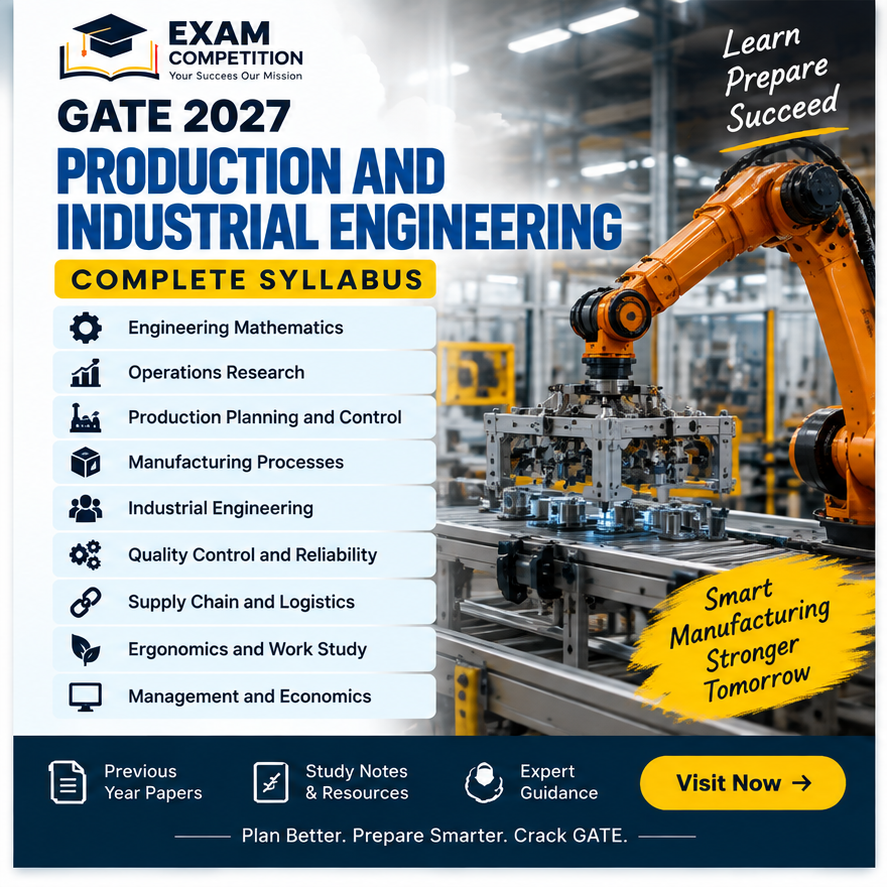
The GATE 2027 Production and Industrial Engineering (PI) paper covers mathematics, engineering fundamentals, manufacturing technologies, quality management, reliability, industrial engineering, operations research and production management.
The official syllabus published by IIT Madras is divided into seven major sections. Candidates preparing for GATE PI should cover every section systematically because the syllabus combines manufacturing, mechanical engineering fundamentals and industrial engineering concepts.
GATE 2027 PI Syllabus at a Glance
| Section | Major Areas |
|---|---|
| Section 1: Engineering Mathematics | Linear Algebra, Calculus, Differential Equations, Probability and Statistics, and Numerical Methods |
| Section 2: General Engineering | Engineering Materials, Applied Mechanics, Theory of Machines and Design, Thermal Engineering and Fluid Engineering |
| Section 3: Manufacturing Processes I | Casting, Metal Forming, Joining of Materials, Powder Processing, Polymers and Composites |
| Section 4: Manufacturing Processes II | Machining, Machine Tools, Advanced Manufacturing and Computer Integrated Manufacturing |
| Section 5: Quality and Reliability | Metrology and Inspection, Quality Management, Reliability and Maintenance |
| Section 6: Industrial Engineering | Product Design and Development, Work System Design and Facility Design |
| Section 7: Operations Research and Operations Management | Operations Research, Engineering Economy and Costing, Production Control and Project Management |
GATE 2027 PI Exam Pattern
According to the official GATE 2027 question paper pattern, the PI paper is a 100-mark paper with 15 marks for General Aptitude and 85 marks for the selected subject. For PI, the subject marks include 13 marks of Engineering Mathematics and 72 marks of Production and Industrial Engineering subject questions. The examination duration is 180 minutes.
| Component | Marks |
|---|---|
| General Aptitude | 15 |
| Engineering Mathematics | 13 |
| Production and Industrial Engineering Subject | 72 |
| Total | 100 |
| Duration | 180 minutes |
Section 1: Engineering Mathematics
Engineering Mathematics is the first section of the official GATE PI syllabus. It covers linear algebra, calculus, differential equations, probability and statistics, and numerical methods.
1. Linear Algebra
- Matrix algebra
- Systems of linear equations
- Eigenvalues and eigenvectors
2. Calculus
- Functions of a single variable
- Limit, continuity and differentiability
- Mean value theorems
- Evaluation of definite integrals
- Partial derivatives
- Total derivatives
- Maxima and minima
- Gradient, divergence and curl
- Vector identities
- Directional derivatives
- Line, surface and volume integrals
- Stokes', Gauss' and Green's theorems
- Taylor series
3. Differential Equations
| Topic | Coverage |
|---|---|
| First Order Equations | Linear and nonlinear first-order equations |
| Higher Order Equations | Higher-order linear differential equations with constant coefficients |
| Special Equations | Cauchy's and Euler's equations |
| Problems | Initial and boundary value problems |
| Transforms | Laplace transform |
4. Probability and Statistics
- Definitions of probability
- Sampling theorems
- Conditional probability
- Mean, median, mode and standard deviation
- Linear regression
- Random variables
- Poisson distribution
- Normal distribution
- Binomial distribution
- Exponential distribution
5. Numerical Methods
- Numerical solutions of linear algebraic equations
- Numerical solutions of nonlinear algebraic equations
- Numerical integration using trapezoidal rule
- Numerical integration using Simpson's rule
- Single-step methods for differential equations
- Multi-step methods for differential equations
Section 2: General Engineering
1. Engineering Materials
This part covers the structure, properties and applications of common engineering materials along with phase diagrams, heat treatment and stress-strain behaviour.
| Topic | Detailed Coverage |
|---|---|
| Engineering Materials | Structure, physical and mechanical properties, and applications of metals and alloys, semiconductors, ceramics, polymers and composites |
| Composites | Metal-, polymer- and ceramic-based composites |
| Phase Diagram | Iron-carbon equilibrium phase diagram |
| Heat Treatment | Heat treatment of metals and alloys and its influence on mechanical properties |
| Mechanical Behaviour | Stress-strain behaviour of metals and alloys |
2. Applied Mechanics
- Equivalent force systems
- Free body concepts
- Equations of equilibrium
- Stress and strain
- Relationship between stress and strain
- Failure theories
- Mohr's circle for stress
- Deflection of beams
- Bending and shear stresses
- Thick and thin cylinders
- Torsion
3. Theory of Machines and Design
| Area | Topics |
|---|---|
| Mechanisms | Analysis of planar mechanisms |
| Cams | Cams and followers |
| Governors and Flywheels | Governors and flywheels |
| Joints | Design of bolted, riveted and welded joints |
| Fits | Interference and shrink fit joints |
| Friction | Friction and lubrication |
| Machine Elements | Design of shafts, keys, couplings, spur gears, belt drives, brakes and clutches |
4. Thermal and Fluids Engineering
Fluid Mechanics:
- Fluid statics
- Bernoulli's equation
- Flow through pipes
- Laminar and turbulent flows
- Equations of continuity and momentum
- Capillary action
- Dimensional analysis
Thermodynamics:
- Zeroth law of thermodynamics
- First law of thermodynamics
- Second law of thermodynamics
- Thermodynamic systems and processes
- Calculation of work and heat for systems and control volumes
- Air standard cycles
Heat Transfer:
- Basic applications of conduction
- Basic applications of convection
- Basic applications of radiation
Section 3: Manufacturing Processes I
1. Casting
| Topic | Detailed Coverage |
|---|---|
| Casting Processes | Types of casting processes and their applications |
| Sand Casting | Patterns, pattern types, materials and allowances |
| Moulds and Cores | Materials, making and testing of moulds and cores |
| Gating and Risers | Design of gating systems and risers |
| Solidification | Analysis of solidification and microstructure development |
| Other Casting Techniques | Pressure die casting, centrifugal casting and investment casting |
| Defects | Casting defects and inspection using non-destructive testing |
2. Metal Forming
- Stress-strain relations in elastic and plastic deformation
- von Mises and Tresca yield criteria
- Concept of flow stress
- Hot, warm and cold working
- Forging
- Rolling
- Extrusion
- Wire drawing
- Blanking
- Punching
- Bending
- Deep drawing
- Ideal work and slab analysis
- Defects in metal working and their causes
3. Joining of Materials
| Area | Topics |
|---|---|
| Joining Processes | Classification of joining processes |
| Fusion Welding | Principles of fusion welding using flame, arc, resistance, laser and electron beam heat sources |
| Welding Heat Transfer | Heat transfer and associated losses |
| Arc Welding | SMAW, GMAW, GTAW, plasma arc and submerged arc welding |
| Solid State Welding | Friction welding, friction stir welding and ultrasonic welding |
| Welding Defects | Causes of welding defects and inspection |
| Other Joining Processes | Adhesive joining, brazing and soldering |
4. Powder Processing
- Production of metal powders
- Production of ceramic powders
- Compaction of metal and ceramic powders
- Sintering of metal and ceramic powders
5. Polymers and Composites
- Injection molding
- Compression molding
- Blow molding
- Extrusion
- Calendaring
- Thermoforming
- Molding of composites
Section 4: Manufacturing Processes II
1. Machining
| Area | Detailed Coverage |
|---|---|
| Machining Fundamentals | Orthogonal and oblique machining |
| Cutting Tools | Single point cutting tool and tool signature |
| Chip Formation | Chip formation and cutting forces |
| Merchant Analysis | Merchant's analysis |
| Energy and Power | Specific cutting energy and power |
| Machining Parameters | Machining parameters and material removal rate |
| Tools | Tool materials, tool wear and tool life |
| Thermal Aspects | Thermal aspects of machining and cutting fluids |
| Machinability | Machinability and economics of machining |
| Machining Processes | Turning, taper turning, thread cutting, drilling, boring, milling, gear cutting and thread production |
| Finishing | Grinding, honing, lapping and super-finishing |
2. Machine Tools
- Lathe machines
- Milling machines
- Drilling machines
- Shaping machines
- Construction and kinematics of machine tools
- Jigs and fixtures
- Principles, applications and design of jigs and fixtures
3. Advanced Manufacturing
| Technology | Coverage |
|---|---|
| USM | Ultrasonic machining: principles and applications |
| AJM | Abrasive jet machining: principles and applications |
| WJM and AWJM | Water jet and abrasive water jet machining |
| EDM | Electrical discharge machining |
| LBM | Laser beam machining |
| EBM | Electron beam machining |
| PAM | Plasma arc machining |
| CHM | Chemical machining |
| ECM | Electrochemical machining |
| Process Parameters | Effect of process parameters on material removal rate, surface roughness and power consumption |
| Additive Manufacturing | Fundamentals, stereolithography, fused filament fabrication, selective laser sintering, selective laser melting and directed energy deposition |
4. Computer Integrated Manufacturing
- Basic concepts of CAD and CAM
- CNC
- Automation in manufacturing
- Industrial robots: configurations, drives and controls
- Cellular manufacturing and FMS
- Group technology
- Introduction to Internet of Things
- Digital twins
Section 5: Quality and Reliability
1. Metrology and Inspection
| Topic | Detailed Coverage |
|---|---|
| Measurement Quality | Accuracy and precision |
| Errors | Types of errors |
| Fits and Tolerances | Limits, fits and tolerances |
| Gauge Design | Gauge design |
| Interchangeability | Interchangeability and selective assembly |
| Geometric Measurements | Linear, angular and form measurements including straightness, flatness, roundness, runout and cylindricity |
| Measurement Methods | Mechanical and optical measurement methods |
| Threads and Gears | Inspection of screw threads and gears |
| Surface Roughness | Contact and non-contact methods for surface roughness measurement |
2. Quality Management
- Quality concepts and cost
- Statistical quality control
- Process capability analysis
- Control charts for variables
- Control charts for attributes
- Acceptance sampling
- Six Sigma
- Total Quality Management
- Just-in-Time inventory management
- Quality assurance and certification
- ISO 9001:2015
- ISO 14001:2015
- Integration of sustainable manufacturing with quality management
3. Reliability and Maintenance
| Area | Topics |
|---|---|
| Reliability Concepts | Reliability, availability and maintainability |
| Failure and Repair | Distribution of failure and repair times |
| Maintenance Metrics | Determination of MTBF and MTTR |
| Reliability Models | Reliability models and determination of system reliability |
| Maintenance Strategies | Preventive and predictive maintenance and replacement |
| TPM | Total productive maintenance |
Section 6: Industrial Engineering
1. Product Design and Development
- Principles of product design
- Tolerance design
- Quality and cost considerations
- Product life cycle
- Standardization
- Simplification
- Diversification
- Value engineering and analysis
- Concurrent engineering
- Design for X
2. Work System Design
| Topic | Coverage |
|---|---|
| Scientific Management | Taylor's scientific management |
| Work Study | Gilbreths' contributions, method study and micro-motion study |
| Motion Economy | Principles of motion economy |
| Productivity | Productivity concepts and measurements |
| Work Measurement | Time study, work sampling, standard data and PMTS |
| Ergonomics | Ergonomics |
| Job Evaluation | Job evaluation and merit rating |
3. Facility Design
- Facility location factors
- Evaluation of alternate locations
- Types of plant layout
- Evaluation of plant layouts
- Assembly line balancing
- Material handling systems
Section 7: Operations Research and Operations Management
1. Operations Research
| Topic | Detailed Coverage |
|---|---|
| Linear Programming | Problem formulation, simplex method, duality and sensitivity analysis |
| Transportation | Transportation models |
| Assignment | Assignment models |
| Integer Programming | Integer programming |
| Queuing | Markovian queuing models |
| Simulation | Introduction to discrete event simulation |
2. Engineering Economy and Costing
- Elementary cost accounting
- Methods of depreciation
- Break-even analysis
- Activity based costing
3. Production Control
| Area | Topics |
|---|---|
| Forecasting | Causal and time-series models, moving average, exponential smoothing, trend and seasonality |
| Production Planning | Aggregate production planning |
| Scheduling | Master production scheduling |
| MRP | MRP, MRP-II and ERP |
| Production Operations | Routing, scheduling and priority dispatching |
| Production Systems | Push and pull production systems |
| Lean and Agile Manufacturing | Concepts of lean and agile manufacturing systems |
| Supply Chain | Logistics, distribution and supply chain management |
| Inventory | Inventory functions, costs, classifications, deterministic inventory models and quantity discount |
| Inventory Control | Perpetual and periodic inventory control systems |
4. Project Management
- Critical Path Method (CPM)
- Program Evaluation and Review Technique (PERT)
- Gantt chart
- Time-cost tradeoff
Important GATE PI Topics for Preparation
| Section | Key Preparation Areas |
|---|---|
| Engineering Mathematics | Linear algebra, calculus, differential equations, probability, statistics and numerical methods |
| General Engineering | Materials, mechanics, machine design, thermodynamics, fluid mechanics and heat transfer |
| Manufacturing Processes I | Casting, metal forming, welding, powder processing, polymers and composites |
| Manufacturing Processes II | Machining, machine tools, advanced manufacturing, additive manufacturing, CAD/CAM, CNC and automation |
| Quality and Reliability | Metrology, inspection, statistical quality control, Six Sigma, quality management, reliability and maintenance |
| Industrial Engineering | Product design, value engineering, work study, productivity, ergonomics, facility location and plant layout |
| Operations Research and Management | Linear programming, transportation, assignment, queuing, simulation, costing, forecasting, MRP, inventory, supply chain and project management |
How to Prepare for GATE Production and Industrial Engineering 2027
GATE PI preparation requires a balanced approach because the syllabus combines mathematical methods, engineering fundamentals, manufacturing technology and industrial management. Candidates should begin by dividing the syllabus into manageable sections and maintaining separate notes for formulas, manufacturing processes and operations-management concepts.
Engineering Mathematics should be revised regularly because it forms part of the subject section of the PI paper. Linear algebra, calculus, differential equations, probability and statistics and numerical methods should be practised through numerical problems.
Manufacturing Processes I and II form a major part of the technical preparation. Candidates should understand the working principles, applications, process parameters, defects and advantages or limitations of different manufacturing processes rather than relying only on memorisation.
Quality and Reliability requires a strong understanding of statistical quality control, process capability, control charts, acceptance sampling, reliability measures and maintenance strategies. Numerical practice is particularly useful for these topics.
Industrial Engineering and Operations Management should be prepared with emphasis on problem-solving techniques. Linear programming, transportation and assignment models, queuing, forecasting, inventory, scheduling, CPM and PERT can involve calculation-based questions.
Candidates should also solve previous GATE questions and take timed mock tests after completing individual sections. This helps identify weak areas and improves speed when solving numerical and analytical questions.
GATE 2027 PI Syllabus PDF
The official IIT Madras GATE 2027 syllabus should be treated as the primary reference for Production and Industrial Engineering preparation. Candidates should check the official document for the complete and updated list of topics.
Download GATE 2027 PI Syllabus PDF
Frequently Asked Questions
What is the GATE PI paper?
How many sections are there in the GATE PI syllabus?
What are the seven sections of GATE PI?
Does GATE PI include Engineering Mathematics?
Does GATE PI include Manufacturing Processes?
Is Operations Research included in GATE PI?
Does GATE PI cover Quality and Reliability?
What is the total duration of the GATE PI paper?
Source: IIT Madras