GATE Robotics and Automation Syllabus 2027: Complete RA Syllabus and Topics
GATE Robotics and Automation Syllabus 2027
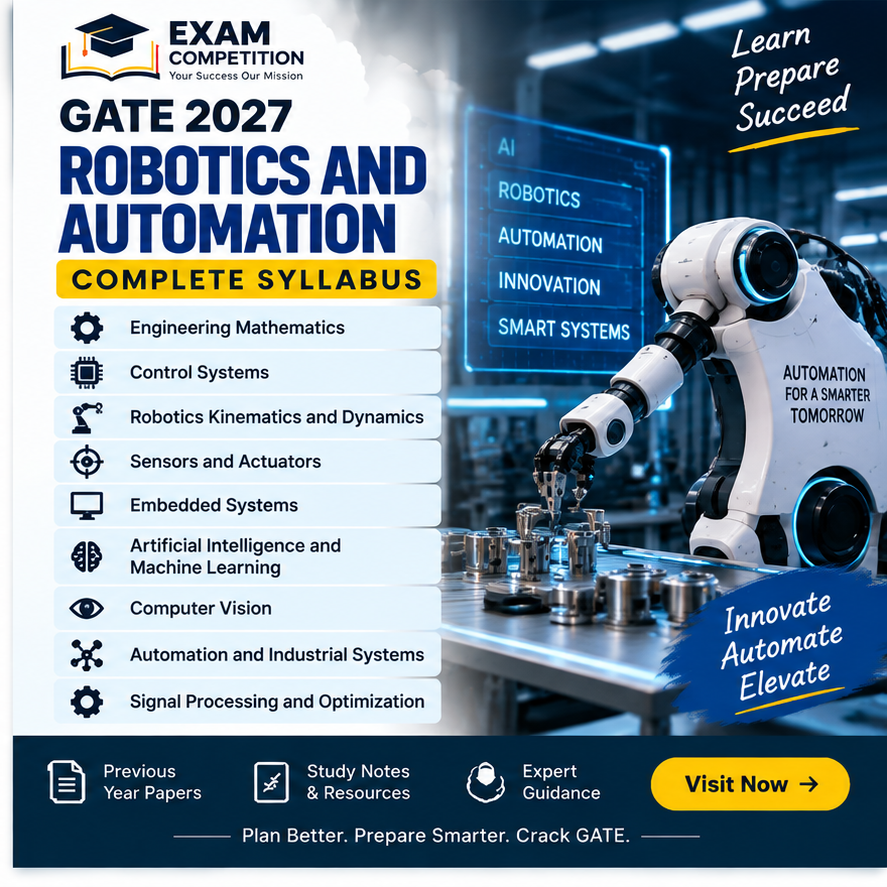
The GATE Robotics and Automation (RA) paper is the new test paper introduced by IIT Madras for GATE 2027. The syllabus combines engineering mathematics, mechatronics, robotics, automation, programming, data structures, electrical engineering and mechanical engineering concepts.
The official RA syllabus is divided into a Common Section and two optional sections. Part A is common to all RA candidates and covers Engineering Mathematics, Basics of Mechatronics and Principles of Robotics and Automation. Candidates then select either Part B1: Electrical Engineering or Part B2: Mechanical Engineering during the examination.
GATE RA Syllabus at a Glance
| Part | Section | Major Areas |
|---|---|---|
| Part A: Common Section | A.1 Engineering Mathematics | Linear Algebra, Calculus, Differential Equations, Probability and Statistics, Numerical Methods |
| A.2 Basics of Mechatronics | Electrical Networks, Digital Circuits, Sensors, Actuators, Engineering Mechanics, Python Programming and Data Structures | |
| A.3 Principles of Robotics and Automation | Robot Classification, Coordinate Systems, Transformations, Kinematics, Robot Applications and Computer Integrated Manufacturing | |
| Part B1 | B1.1 Analog Circuits and Embedded Systems | Analog Circuits, Operational Amplifiers, Oscillators, Converters, Microprocessors, Microcontrollers and Data Acquisition |
| Part B1 | B1.2 Signals and Systems | Continuous and Discrete Signals, LTI Systems, Fourier Analysis, Sampling, Laplace Transform and Z Transform |
| Part B1 | B1.3 Control Systems | System Modeling, Transfer Functions, Stability, Bode Plots, Root Locus, Compensators and PID Controllers |
| Part B2 | B2.1 Mechanics of Materials | Stress, Strain, Mohr's Circle, Beam Analysis, Torsion, Columns, Fatigue, Strain Gauges and Material Testing |
| Part B2 | B2.2 Kinematics and Dynamics | Mechanisms, Linkages, Gears, Balancing, Gyroscopes, Vibrations and Critical Speeds |
| Part B2 | B2.3 Machine Design and Computer Integrated Manufacturing | Machine Design, Failure Theories, Fatigue, Machine Elements, CAD/CAM and Additive Manufacturing |
GATE RA Exam Pattern
According to the official GATE 2027 question paper pattern, the RA paper carries 100 marks and has a duration of 180 minutes. General Aptitude accounts for 15 marks. The remaining 85 marks are divided between the common section and the selected Part B section.
Candidates can select either Part B1: Electrical Engineering or Part B2: Mechanical Engineering during the examination. Part A is common to both choices.
| Component | Marks |
|---|---|
| General Aptitude | 15 |
| Part A: Common Section | 60 |
| Part B1: Electrical Engineering | 25 |
| Part B2: Mechanical Engineering | 25 |
| Total attempted paper | 100 |
| Examination Duration | 180 minutes |
Part A: Common Section
Section A.1: Engineering Mathematics
Engineering Mathematics forms the first part of the common RA syllabus. It covers linear algebra, calculus, differential equations, probability and statistics, and numerical methods.
Linear Algebra
- Matrices
- Transpose
- Determinant
- Rank
- Eigenvalues and eigenvectors
- Trace
- Adjoint
- Solutions to systems of linear equations
Calculus
- Functions of a single variable
- Limits
- Continuity and differentiability
- Mean value theorems
- Indeterminate forms
- Definite and improper integrals
- Double and triple integrals
- Partial derivatives
- Total derivative
- Taylor series in one and two variables
- Maxima and minima
- Gradient, divergence and curl
- Vector identities
Differential Equations
| Topic | Coverage |
|---|---|
| First-Order Equations | Linear and nonlinear first-order equations |
| Higher-Order Equations | Higher-order linear differential equations with constant coefficients |
| Euler-Cauchy Equation | Euler-Cauchy equation |
| Initial and Boundary Problems | Initial and boundary value problems |
| Transforms | Laplace transforms |
| Partial Differential Equations | Solutions of heat, wave and Laplace's equations |
| Fourier Series | Fourier series |
Probability and Statistics
- Axioms of probability
- Conditional probability
- Mean, median and mode
- Standard deviation
- Random variables
- Expectation
- Binomial distribution
- Poisson distribution
- Normal distribution
- Hypothesis testing
- Probability Density Function (PDF)
- Cumulative Distribution Function (CDF)
Numerical Methods
- Solutions of linear algebraic equations
- Solutions of nonlinear algebraic equations
- Trapezoidal rule for numerical integration
- Simpson's rule for numerical integration
- Finite differences
- Explicit single-step methods for differential equations
- Explicit multi-step methods for differential equations
Section A.2: Basics of Mechatronics
Network Elements and Electrical Circuits
| Area | Topics |
|---|---|
| Network Elements | Ideal voltage and current sources, dependent sources, R, L, C and M elements |
| Network Analysis | Kirchhoff's laws, KCL, KVL, node analysis and mesh analysis |
| Network Theorems | Thevenin's theorem, Norton's theorem, superposition theorem and maximum power transfer theorem |
| Transient Analysis | Transient response of DC and AC networks |
| AC Circuits | Sinusoidal steady-state analysis, resonance, two-port networks and balanced three-phase circuits |
| AC Power | Complex power and power factor in AC circuits |
Digital Circuits
- Boolean algebra
- Combinational circuits
- Multiplexers
- Encoders
- Decoders
- Sequential circuits
- Flip-flops
- Counters
Sensors
The RA syllabus includes resistive, capacitive, inductive, piezoelectric and Hall-effect sensors together with associated signal-conditioning circuits.
Industrial instrumentation transducers include measurement of displacement, both linear and angular, velocity, acceleration, force, torque and pressure.
Actuators
- Hydraulic actuators
- Pneumatic actuators
- DC motors
- Stepper motors
- Servo motors
- Principles of operation
- Performance characteristics
- Torque-speed characteristics
Engineering Mechanics
- Free-body diagrams
- Equilibrium
- Friction and its applications
- Rolling friction
- Belt-pulley systems
- Trusses and frames
- Kinematics of rigid bodies in plane motion
- Dynamics of rigid bodies in plane motion
Programming
| Programming Area | Topics |
|---|---|
| Program Design | Flowcharts and pseudocode |
| Python Basics | Data types, operators and expressions |
| Conditional Statements | if, elif, else and case statements |
| Loops | while and for loops |
| Loop Control | break and continue |
| Functions | Functions and recursion |
| Data Handling | Arrays, dictionaries and strings |
Data Structures
- Stack
- Queue
- Linked list
- Binary search tree
- Binary heap
- Graph
Section A.3: Principles of Robotics and Automation
Robotics Fundamentals
| Area | Topics |
|---|---|
| Robot Classification | Serial and parallel manipulators |
| Robot Configuration | Geometrical configuration |
| Links and Joints | Links, joints, coordinate systems and degrees of freedom |
| Transformations | Rotation matrices in two and three dimensions |
| Homogeneous Transformation | Homogeneous transformations |
| Kinematics | Forward kinematics |
| Robot Control | Point-to-point and continuous path control |
| End Effectors | Types of end-effectors |
| Robot Performance | Robot accuracy and repeatability |
Computer Integrated Manufacturing
- Automation in manufacturing
- Programmable Logic Controllers (PLCs) in manufacturing
- Automated material handling systems
- Automated storage and retrieval systems
- Automated identification, detection and capture systems
- Computer numerical control
- Basics of single-axis positioning systems
- Basics of multi-axis positioning systems
- Concurrent design and manufacturing planning for automation
Part B1: Electrical Engineering
Section B1.1: Analog Circuits and Embedded Systems
| Area | Topics |
|---|---|
| Analog Filters | Low-pass, high-pass, band-pass and band-reject filters |
| Amplifiers | Biasing, equivalent circuit, frequency response and feedback amplifiers |
| Operational Amplifiers | Characteristics and applications of operational amplifiers |
| Oscillators | Oscillators |
| VCO and Timers | Voltage Controlled Oscillators and timers |
| Waveform Circuits | Schmitt triggers and sample-and-hold circuits |
| Data Conversion | Analog-to-Digital and Digital-to-Analog converters |
| Power Electronics | Switched Mode Power Supplies (SMPS) |
| Microcontrollers | Microprocessor and microcontroller applications |
| Microcontroller Components | CPU, memory, I/O ports and timers |
| Interrupts | Interrupt handling |
| Interfacing | Memory and input-output interfacing |
| Data Acquisition | Basics of data acquisition systems |
Section B1.2: Signals and Systems
- Continuous-time signals
- Discrete-time signals
- Signal shifting and scaling
- Linear time-invariant systems
- Causal systems
- Fourier series representation of continuous-time periodic signals
- Fourier series representation of discrete-time periodic signals
- Shannon sampling theorem
- Fourier Transform
- Laplace Transform
- Z Transform
- RMS value
- Average value calculations
Section B1.3: Control Systems
| Topic | Coverage |
|---|---|
| System Modeling | Mathematical modeling and representation of systems |
| Feedback | Feedback principle |
| Transfer Function | Transfer function |
| Block Diagrams | Block diagrams and signal flow graphs |
| System Response | Transient and steady-state analysis of linear time-invariant systems |
| Stability | Routh-Hurwitz and Nyquist criteria |
| Frequency Response | Bode plots |
| Root Locus | Root locus analysis |
| Compensators | Lag, lead and lead-lag compensators |
| Controllers | P, PI and PID controllers |
Part B2: Mechanical Engineering
Section B2.1: Mechanics of Materials
- Stress and strain
- Elastic constants
- Poisson's ratio
- Mohr's circle for plane stress and plane strain
- Thin cylinders
- Shear force diagrams
- Bending moment diagrams
- Bending stresses
- Shear stresses
- Shear centre
- Deflection of beams
- Torsion of circular shafts
- Euler's theory of columns
- Castigliano's theorems
- Thermal stresses
- Strain gauges and rosettes
- Testing of materials with universal testing machine
- Testing of hardness
- Testing of impact strength
Section B2.2: Kinematics and Dynamics
| Area | Topics |
|---|---|
| Mechanism Analysis | Displacement, velocity and acceleration analysis of plane mechanisms |
| Linkages | Dynamic analysis of linkages |
| Gears | Gears and gear trains |
| Balancing | Balancing of reciprocating and rotating masses |
| Gyroscope | Gyroscope |
| Vibrations | Free and forced vibration of single-degree-of-freedom systems |
| Damping | Effect of damping and vibration isolation |
| Resonance | Resonance |
| Critical Speeds | Critical speeds of shafts |
Section B2.3: Machine Design and Computer Integrated Manufacturing
- Design for static loading
- Design for dynamic loading
- Failure theories
- Fatigue strength
- S-N diagram
- Design of bolted joints
- Design of riveted joints
- Design of welded joints
- Design of shafts
- Rolling contact bearings
- Sliding contact bearings
- Brakes
- Clutches
- Springs
- Basic concepts of Computer Aided Design (CAD)
- Basic concepts of Computer Aided Manufacturing (CAM)
- CAD/CAM integration tools
- Additive manufacturing
Electrical vs Mechanical Optional Section
The RA paper gives candidates a choice between an Electrical Engineering section and a Mechanical Engineering section. Candidates should select the option that best matches their preparation background and strengths.
| Part | Best Suited For | Main Areas |
|---|---|---|
| B1: Electrical Engineering | Candidates with electrical, electronics, instrumentation and control-system background | Analog Circuits, Embedded Systems, Signals and Systems, Control Systems |
| B2: Mechanical Engineering | Candidates with mechanical, robotics, manufacturing and machine-design background | Mechanics of Materials, Kinematics, Dynamics, Machine Design and CAD/CAM |
Important Topics for GATE Robotics and Automation
| Area | Important Topics |
|---|---|
| Engineering Mathematics | Linear algebra, calculus, differential equations, probability, statistics and numerical methods |
| Mechatronics | Electrical networks, digital circuits, sensors, actuators and engineering mechanics |
| Programming | Python, flowcharts, functions, recursion, arrays, dictionaries and strings |
| Data Structures | Stacks, queues, linked lists, binary search trees, binary heaps and graphs |
| Robotics | Robot classification, degrees of freedom, coordinate systems, rotation matrices, homogeneous transformations and forward kinematics |
| Automation | PLCs, automated material handling, AS/RS, automated identification, CNC and positioning systems |
| Electrical Option | Analog circuits, embedded systems, signals and systems, control systems |
| Mechanical Option | Mechanics of materials, kinematics, dynamics, machine design, CAD/CAM and additive manufacturing |
How to Prepare for GATE Robotics and Automation
Preparation for GATE RA should begin with the common section because every candidate has to study Part A. Engineering Mathematics should be revised regularly, particularly linear algebra, calculus, differential equations, probability and statistics, and numerical methods.
The mechatronics section requires candidates to connect concepts from electrical circuits, digital electronics, sensors, actuators and mechanics. Candidates should practise circuit-analysis problems and understand how sensors and actuators are used in automated systems.
Programming and data structures are important additions to the RA syllabus. Candidates should practise Python syntax and problem solving rather than limiting preparation to theoretical definitions. Flowcharts, pseudocode, functions, recursion and basic data structures should be revised repeatedly.
Robotics preparation should focus on coordinate systems, degrees of freedom, rotation matrices, homogeneous transformations and forward kinematics. Candidates should also understand robot applications, end-effectors, point-to-point control, continuous-path control, accuracy and repeatability.
Candidates choosing the Electrical option should focus on analog circuits, embedded systems, signals and systems and control systems. Candidates choosing the Mechanical option should concentrate on mechanics of materials, kinematics and dynamics, machine design and CAD/CAM.
After completing the syllabus, candidates should solve previous relevant engineering questions and take timed mock tests. Because the RA paper combines several disciplines, regular mixed-topic practice can help improve speed and reduce switching time between different types of problems.
GATE Robotics and Automation Syllabus PDF
Candidates should use the official IIT Madras syllabus as the primary reference for GATE Robotics and Automation preparation. The official document contains the complete common syllabus and both optional sections.
Download GATE Robotics and Automation Syllabus PDF
Frequently Asked Questions
What is the GATE RA paper?
What are the sections in the GATE RA syllabus?
Can I choose between Electrical and Mechanical sections in GATE RA?
How many marks is the GATE RA paper?
Does GATE RA include Engineering Mathematics?
Does GATE RA include Python programming?
Does GATE RA include robotics kinematics?
Is Computer Integrated Manufacturing included in GATE RA?
What is the duration of the GATE RA examination?
Source: IIT Madras