GATE Statistics Syllabus 2027: Complete ST Syllabus and Topics
GATE Statistics Syllabus 2027
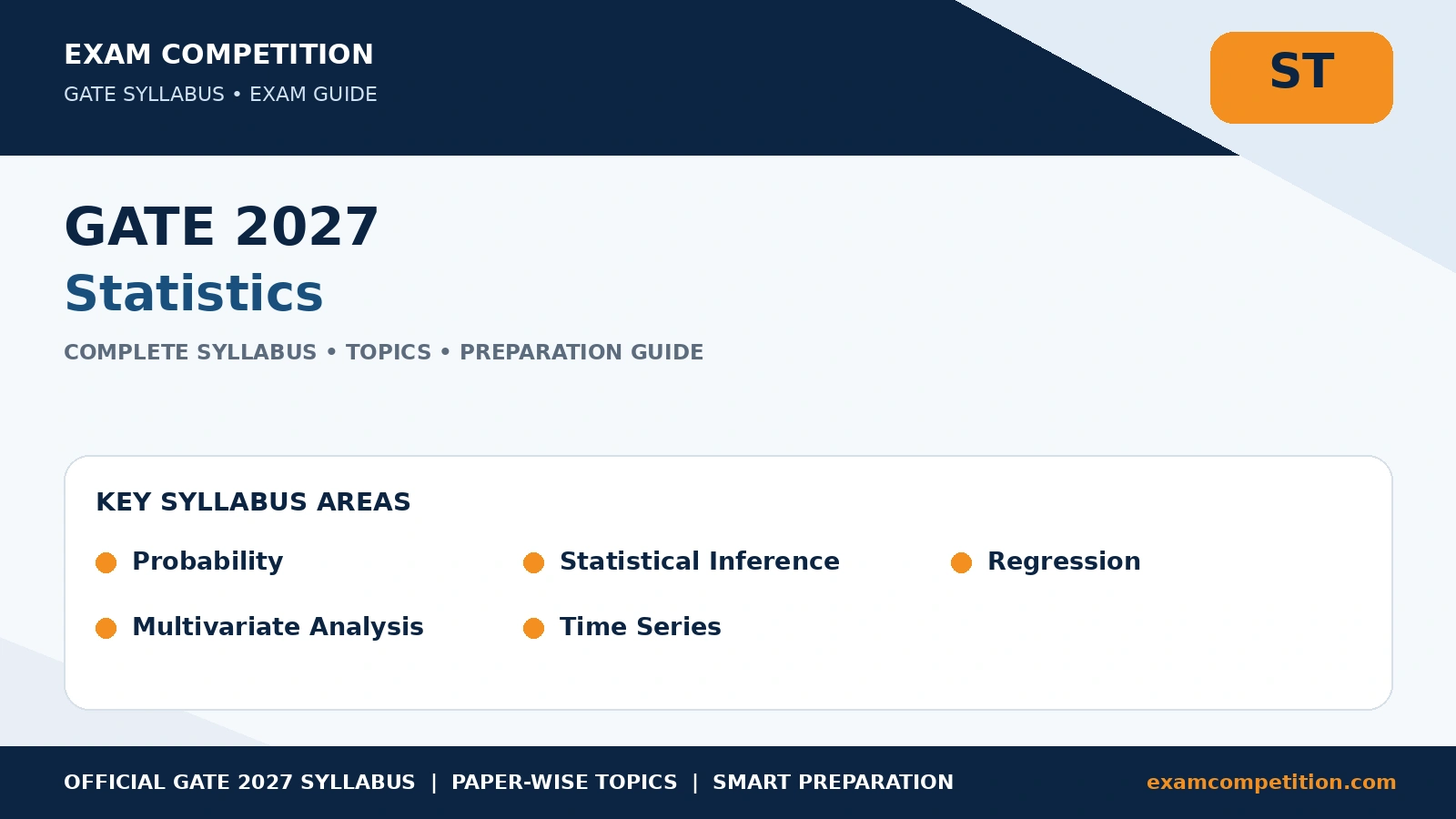
The GATE 2027 Statistics (ST) paper covers a comprehensive range of mathematical statistics and probability topics. The official syllabus published by IIT Madras contains twelve sections, beginning with Calculus and Matrix Theory and progressing through probability, distributions, stochastic processes, statistical inference, non-parametric methods, multivariate analysis and regression.
Candidates preparing for GATE ST should develop a strong foundation in mathematical concepts as well as statistical theory. Many sections are closely connected, so concepts from probability and distributions are particularly important for understanding estimation, hypothesis testing, multivariate analysis and regression.
GATE 2027 ST Syllabus at a Glance
| Section | Major Areas |
|---|---|
| Section 1: Calculus | Sequences and series, functions of real variables, differentiation, Taylor's theorem, Riemann integration, improper integrals, multivariable calculus and multiple integrals |
| Section 2: Matrix Theory | Vector spaces, rank and nullity, matrix operations, linear systems, inner products, eigenvalues, diagonalization, quadratic forms and singular value decomposition |
| Section 3: Probability | Probability axioms, conditional probability, Bayes' theorem, random variables, distributions, expectation, moments, generating functions and probability inequalities |
| Section 4: Standard Univariate Distributions | Discrete and continuous probability distributions including Bernoulli, binomial, Poisson, gamma, beta, Weibull, normal and Cauchy distributions |
| Section 5: Joint Distributions | Joint, marginal and conditional distributions, conditional expectation, correlation, order statistics, multinomial distribution, bivariate normal distribution and sampling distributions |
| Section 6: Convergence of Random Variables | Convergence in distribution, probability, almost surely and in r-th mean, Slutsky's lemma, Borel-Cantelli lemma, laws of large numbers and central limit theorem |
| Section 7: Stochastic Processes | Markov chains, stationary distributions, Poisson process, birth-and-death processes, pure-birth processes, pure-death processes and Brownian motion |
| Section 8: Estimation | Sufficiency, completeness, unbiased estimation, UMVU estimation, Rao-Blackwell theorem, Lehmann-Scheffe theorem, Cramer-Rao inequality, consistency, method of moments and maximum likelihood estimation |
| Section 9: Testing of Hypotheses | Neyman-Pearson lemma, most powerful tests, monotone likelihood ratio, uniformly most powerful tests, likelihood ratio tests and large sample tests |
| Section 10: Non-parametric Statistics | Empirical distribution function, goodness-of-fit tests, chi-square test, Kolmogorov-Smirnov test, run tests, sign test, Wilcoxon, Mann-Whitney, Kruskal-Wallis and rank correlation |
| Section 11: Multivariate Analysis | Multivariate normal distribution, maximum likelihood estimation, Hotelling's T-squared test, Wishart distribution and correlation coefficients |
| Section 12: Regression Analysis | Simple and multiple linear regression, R-squared, adjusted R-squared, quadratic forms, Fisher-Cochran theorem, Gauss-Markov theorem, regression tests and confidence intervals |
GATE 2027 ST Exam Pattern
Statistics is one of the GATE papers that has a direct subject-question structure without a separate Engineering Mathematics component. The official GATE 2027 pattern allocates 15 marks to General Aptitude and 85 marks to Statistics, making a total of 100 marks. The examination duration is 180 minutes.
| Component | Marks |
|---|---|
| General Aptitude | 15 |
| Statistics Subject | 85 |
| Total | 100 |
| Duration | 180 minutes |
Section 1: Calculus
The Calculus section establishes the mathematical foundation required for advanced statistical analysis. It covers sequences, series, functions of real variables and multivariable calculus.
Sequences and Series
- Finite, countable and uncountable sets
- Sequences of real numbers
- Convergence of sequences
- Bounded sequences
- Monotonic sequences
- Cauchy criterion for convergence
- Series of real numbers
- Tests of convergence
- Alternating series
- Absolute and conditional convergence
- Power series
- Radius of convergence
Functions of a Real Variable
| Topic | Coverage |
|---|---|
| Limits | Limits of functions of a real variable |
| Continuity | Continuity and uniform continuity |
| Differentiability | Differentiability and monotone functions |
| Mean Value Theorems | Rolle's theorem and mean value theorems |
| Taylor's Theorem | Taylor's theorem |
| L'Hospital Rules | L'Hospital rules |
| Extrema | Maxima and minima |
| Integration | Riemann integration and its properties |
| Improper Integrals | Improper integrals |
Functions of Several Real Variables
- Limits
- Continuity
- Partial derivatives
- Directional derivatives
- Gradient
- Taylor's theorem
- Total derivative
- Maxima and minima
- Saddle points
- Method of Lagrange multipliers
- Double and triple integrals
- Applications of double and triple integrals
Section 2: Matrix Theory
| Area | Topics |
|---|---|
| Vector Spaces | Subspaces of Rn and Cn, span, linear independence, basis and dimension |
| Matrix Spaces | Row space and column space of a matrix |
| Rank and Nullity | Rank, nullity and row reduced echelon form |
| Matrix Operations | Trace, determinant and inverse of a matrix |
| Linear Systems | Systems of linear equations |
| Inner Products | Inner products in Rn and Cn |
| Orthonormalization | Gram-Schmidt orthonormalization |
| Eigen Analysis | Eigenvalues, eigenvectors and characteristic polynomial |
| Cayley-Hamilton | Cayley-Hamilton theorem |
| Special Matrices | Symmetric, skew-symmetric, Hermitian, skew-Hermitian, orthogonal and unitary matrices |
| Change of Basis | Change of basis matrix |
| Equivalence and Similarity | Equivalence, similarity and diagonalizability |
| Positive Matrices | Positive definite and positive semi-definite matrices and their properties |
| Quadratic Forms | Quadratic forms |
| SVD | Singular value decomposition |
Section 3: Probability
Probability is a central component of the Statistics syllabus. Candidates should develop a clear understanding of probability laws, conditional probability, random variables and moments.
- Axiomatic definition of probability
- Properties of the probability function
- Conditional probability
- Bayes' theorem
- Independence of events
- Random variables and their distributions
- Cumulative distribution function
- Probability mass function
- Probability density function
- Expectation
- Variance
- Properties of expectation and variance
- Moments
- Moment generating function
- Probability generating function
- Quantiles
- Distribution of functions of a random variable
- Chebyshev inequality
- Markov inequality
- Jensen inequality
Section 4: Standard Univariate Distributions
Candidates should know the properties and characteristics of the standard discrete and continuous distributions listed in the official syllabus.
| Type | Distributions |
|---|---|
| Discrete Distributions | Bernoulli, binomial, geometric, negative binomial, hypergeometric, discrete uniform and Poisson |
| Continuous Distributions | Continuous uniform, exponential, double exponential, gamma, beta of first and second kinds, Weibull, normal and Cauchy |
Section 5: Joint Distributions
| Topic | Detailed Coverage |
|---|---|
| Joint Distributions | Jointly distributed random variables and their distribution functions |
| Joint PMF and PDF | Joint probability mass functions, probability density functions and their properties |
| Marginal Distributions | Marginal distributions |
| Conditional Distributions | Conditional distributions and conditional expectation |
| Moments | Conditional expectation, moments and product moments |
| Correlation | Simple correlation coefficient |
| Generating Functions | Joint moment generating function |
| Independence | Independence of random variables |
| Functions of Random Vectors | Functions of random vectors and their distributions |
| Order Statistics | Distributions of order statistics and joint and marginal distributions of order statistics |
| Multinomial Distribution | Multinomial distribution |
| Bivariate Normal | Bivariate normal distribution |
| Sampling Distributions | Central chi-square, central t and central F distributions |
Section 6: Convergence of Random Variables
- Convergence in distribution
- Convergence in probability
- Convergence almost surely
- Convergence in r-th mean
- Inter-relations between modes of convergence
- Slutsky's lemma
- Borel-Cantelli lemma
- Weak law of large numbers
- Strong law of large numbers
- Central limit theorem for i.i.d. random variables
Section 7: Stochastic Processes
| Topic | Coverage |
|---|---|
| Markov Chains | Markov chains with finite and countable state spaces |
| Classification of States | Classification of states |
| Transition Probabilities | Limiting behaviour of n-step transition probabilities |
| Stationary Distribution | Stationary distribution |
| Poisson Process | Poisson process |
| Birth and Death | Birth-and-death process |
| Pure Birth | Pure-birth process |
| Pure Death | Pure-death process |
| Brownian Motion | Brownian motion and its basic properties |
Section 8: Estimation
Estimation covers the theoretical foundations of statistical inference as well as important methods for constructing estimators and confidence intervals.
Properties of Statistics and Estimators
- Sufficiency
- Minimal sufficiency
- Factorization theorem
- Completeness
- Completeness of exponential families
- Ancillary statistic
- Basu's theorem and its applications
Estimation Methods
| Method or Property | Topics |
|---|---|
| Unbiased Estimation | Unbiased estimation |
| UMVU Estimation | Uniformly minimum variance unbiased estimation |
| Rao-Blackwell | Rao-Blackwell theorem |
| Lehmann-Scheffe | Lehmann-Scheffe theorem |
| Cramer-Rao | Cramer-Rao inequality |
| Consistency | Consistent estimators |
| Method of Moments | Method of moments estimators |
| Maximum Likelihood | Method of maximum likelihood estimators and their properties |
Interval Estimation
- Pivotal quantities
- Confidence intervals based on pivotal quantities
- Coverage probability
Section 9: Testing of Hypotheses
| Topic | Coverage |
|---|---|
| Neyman-Pearson | Neyman-Pearson lemma |
| Most Powerful Tests | Most powerful tests |
| MLR | Monotone likelihood ratio property |
| UMP Tests | Uniformly most powerful tests |
| UMPU Tests | Uniformly most powerful unbiased tests |
| Exponential Families | Uniformly most powerful unbiased tests for exponential families |
| Likelihood Ratio | Likelihood ratio tests |
| Large Sample Tests | Large sample tests |
Section 10: Non-parametric Statistics
- Empirical distribution function and its properties
- Goodness-of-fit tests
- Chi-square test
- Kolmogorov-Smirnov test
- Run tests
- Sign test
- Wilcoxon signed rank test
- Mann-Whitney U-test
- Kruskal-Wallis test
- Spearman rank correlation coefficient
- Kendall rank correlation coefficient
Section 11: Multivariate Analysis
| Area | Topics |
|---|---|
| Multivariate Normal Distribution | Multivariate normal distribution and its properties |
| Conditional and Marginal Distributions | Conditional and marginal distributions |
| Maximum Likelihood | Maximum likelihood estimation of mean vector and dispersion matrix |
| Hotelling's Test | Hotelling's T2 test |
| Wishart Distribution | Wishart distribution and its basic properties |
| Correlation | Multiple and partial correlation coefficients and their basic properties |
Section 12: Regression Analysis
Regression Analysis is the final section of the official GATE ST syllabus. Candidates should be comfortable with both simple and multiple linear regression and the statistical results associated with regression models.
| Topic | Detailed Coverage |
|---|---|
| Simple Regression | Simple linear regression |
| Multiple Regression | Multiple linear regression |
| Coefficient of Determination | R2 and adjusted R2 and their applications |
| Quadratic Forms | Distributions of quadratic forms of random vectors |
| Fisher-Cochran Theorem | Fisher-Cochran theorem |
| Gauss-Markov Theorem | Gauss-Markov theorem |
| Regression Tests | Tests for regression coefficients |
| Confidence Intervals | Confidence intervals |
Important Topics for GATE Statistics Preparation
| Area | Important Focus |
|---|---|
| Calculus | Sequences, convergence, series, differentiation, Taylor's theorem, integration, multivariable calculus and Lagrange multipliers |
| Matrix Theory | Vector spaces, rank, eigenvalues, eigenvectors, diagonalization, positive definite matrices, quadratic forms and SVD |
| Probability | Conditional probability, Bayes' theorem, random variables, expectation, variance, moments and probability inequalities |
| Distributions | Discrete and continuous standard distributions and their properties |
| Joint Distributions | Marginal and conditional distributions, order statistics, multinomial distribution, bivariate normal and sampling distributions |
| Convergence | Modes of convergence, Slutsky's lemma, Borel-Cantelli lemma, laws of large numbers and central limit theorem |
| Stochastic Processes | Markov chains, Poisson process, birth-and-death processes and Brownian motion |
| Estimation | Sufficiency, completeness, unbiased estimation, UMVU, Rao-Blackwell, Lehmann-Scheffe, Cramer-Rao, MLE and confidence intervals |
| Hypothesis Testing | Neyman-Pearson, most powerful tests, MLR, UMP, UMPU and likelihood ratio tests |
| Non-parametric Statistics | Goodness-of-fit, chi-square, Kolmogorov-Smirnov, sign, Wilcoxon, Mann-Whitney, Kruskal-Wallis and rank correlation tests |
| Multivariate Analysis | Multivariate normal distribution, Hotelling's T2, Wishart distribution and multiple and partial correlations |
| Regression | Simple and multiple regression, R2, adjusted R2, Gauss-Markov theorem, regression tests and confidence intervals |
How to Prepare for GATE Statistics
GATE ST preparation should start with Calculus, Matrix Theory and Probability because these subjects provide the mathematical foundation for many of the later sections. Candidates should solve problems regularly instead of relying only on reading theoretical material.
Probability and standard distributions should be studied together. Candidates should understand the definitions and properties of the distributions in the syllabus and practise problems involving expectation, variance, moments and transformations of random variables.
Joint Distributions and Convergence of Random Variables require particular attention because these topics connect probability theory with statistical inference. Candidates should practise marginal and conditional distributions, order statistics, sampling distributions, modes of convergence, laws of large numbers and the central limit theorem.
Estimation and Testing of Hypotheses should be prepared systematically. Important theoretical results such as the Rao-Blackwell theorem, Lehmann-Scheffe theorem, Cramer-Rao inequality and Neyman-Pearson lemma should be studied along with their applications.
Non-parametric Statistics, Multivariate Analysis and Regression Analysis should be revised after the core probability and inference topics are strong. Candidates should maintain concise notes containing important definitions, assumptions, distributions, test statistics and results.
Regular practice with previous GATE questions and timed mock tests can help candidates improve calculation speed and identify areas requiring additional revision.
GATE Statistics Syllabus PDF
Candidates should use the official IIT Madras syllabus as the primary reference for Statistics preparation. The official PDF contains all twelve sections of the GATE ST syllabus.
Download GATE Statistics Syllabus PDF
Frequently Asked Questions
What is the GATE ST paper?
How many sections are there in the GATE Statistics syllabus?
What are the sections in GATE Statistics?
Does GATE ST have a separate Engineering Mathematics section?
Which probability distributions are included in GATE ST?
Does GATE Statistics include stochastic processes?
Does GATE ST include non-parametric tests?
Is regression analysis included in GATE Statistics?
What is the duration of the GATE ST examination?
Source: IIT Madras