DSSSB TGT Computer Science Exam Attempt Strategy 2026: Time Management and Score Tips
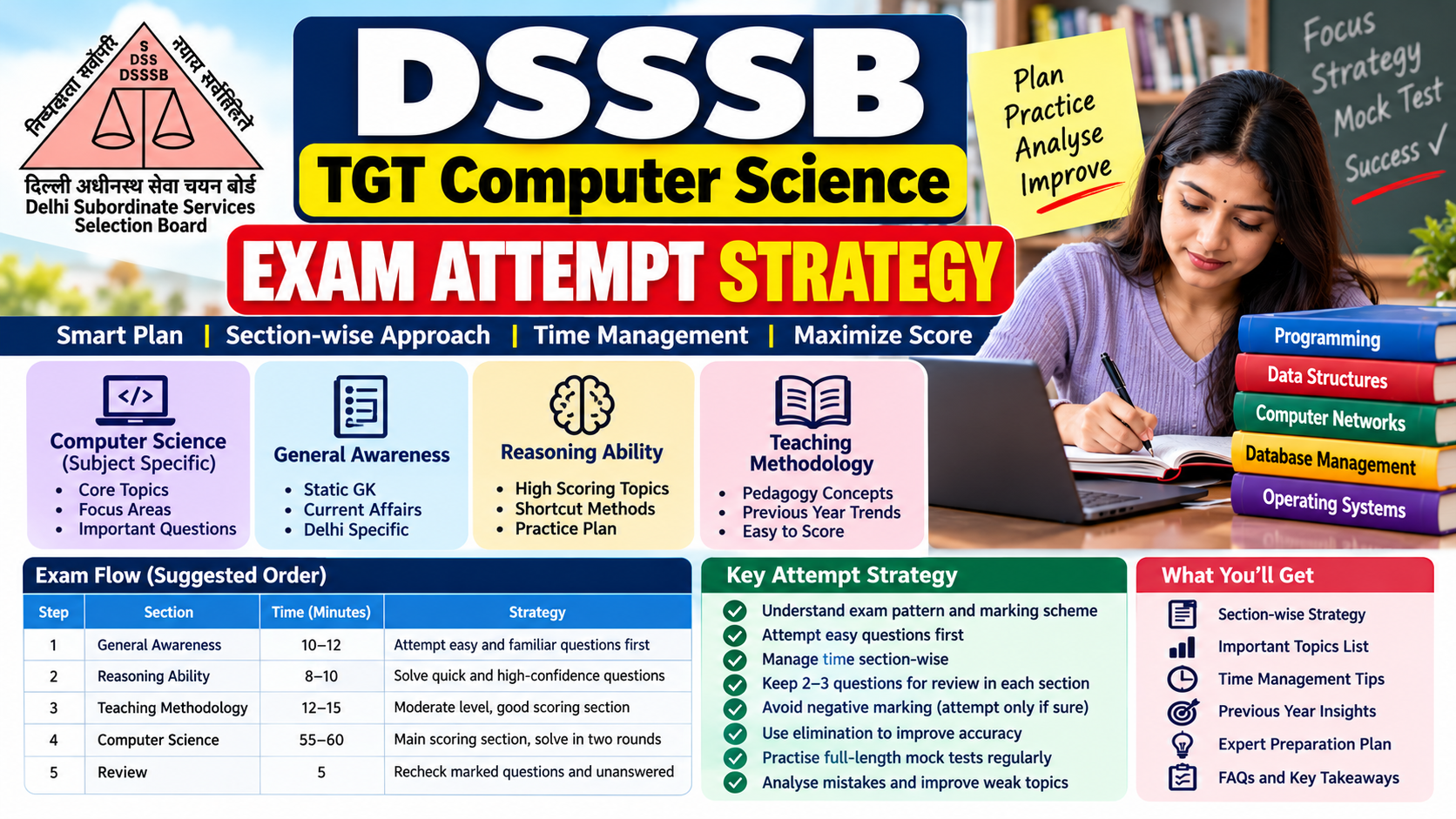
Knowing Computer Science is one part of the preparation. Using those two hours wisely is another. In the DSSSB TGT Computer Science examination, a good attempt strategy helps you protect easy marks, avoid unnecessary negative marking and leave enough time for the questions that actually need thought.
This guide is built around a simple approach: collect the marks you know how to earn, avoid getting stuck, and use the final minutes intelligently. You do not need to attempt every question blindly to get a good score.
DSSSB TGT Computer Science Exam Pattern at a Glance
| Examination type | One-Tier Technical / Teaching examination, as applicable to the recruitment notice |
|---|---|
| Question format | Objective-type multiple-choice questions |
| Total questions | 200 |
| Total marks | 200 |
| Duration | 120 minutes |
| Section A | 100 questions, 100 marks |
| Section B | 100 questions, 100 marks on the concerned subject, including teaching methodology where prescribed |
| Correct answer | +1 mark |
| Incorrect answer | -0.25 mark under the applicable scheme |
| Unanswered question | Normally zero marks; verify the instructions for your examination |
Always confirm the exam scheme, negative marking, section rules and qualifying conditions in the official advertisement applicable to your post code.
1. The Best 120-Minute Attempt Plan
Do not decide your time allocation for the first time inside the examination hall. Practise the same schedule in full-length mock tests until it becomes comfortable.
| Stage | Time | What to do | Goal |
|---|---|---|---|
| Section A | 40 minutes | Attempt familiar General Awareness, Reasoning, Numerical Ability, Hindi and English questions first. | Collect straightforward marks without spending too long on any one question. |
| Section B: Computer Science | 65 minutes | Answer familiar technical questions first, then return to questions that require calculations or deeper reasoning. | Give adequate time to the subject-specific section. |
| Final review | 15 minutes | Review flagged questions, check marked responses and resolve only those questions where you can make a sound decision. | Reduce avoidable errors and confirm that responses are recorded. |
| Total | 120 minutes | A suggested starting plan; adjust it using mock-test performance and the actual examination interface. | |
2. Section-Wise Time Management Strategy
Section A contains five areas. It is tempting to spend too much time on a difficult General Awareness question or a long calculation. Avoid that trap.
| Section A subject | Questions | Suggested time | Attempt approach |
|---|---|---|---|
| General Awareness | 20 | 7 minutes | Answer facts you know; do not turn one uncertain question into a long debate. |
| General Intelligence and Reasoning | 20 | 8 minutes | Start with direct patterns, series, analogies and familiar reasoning formats. |
| Arithmetical and Numerical Ability | 20 | 10 minutes | Prioritise quick calculations; mark lengthy questions for later. |
| Hindi Language and Comprehension | 20 | 7 minutes | Use grammar rules, vocabulary and direct comprehension evidence. |
| English Language and Comprehension | 20 | 8 minutes | Focus on clear grammar, vocabulary and passage-based answers. |
| Total Section A | 100 | 40 minutes | Keep moving and return to difficult questions if time permits. |
These subject-level timings are a starting point, not a prediction of the number of questions you will find easy. If your mock-test data shows that you consistently need more time for Numerical Ability, adjust the allocation without allowing that section to consume the whole paper.
3. How to Attempt the Computer Science Section
Section B carries half the marks in this pattern. The best approach is not to treat every Computer Science question as equally difficult. A direct database question and a lengthy algorithm trace should not automatically receive the same amount of time.
| Topic area | What to look for first | Attempt decision |
|---|---|---|
| Programming and problem-solving | Syntax, output prediction, loops, conditions, functions and common errors | Attempt quickly if the logic is clear; flag long code traces. |
| Data Structures and Algorithms | Basic operations, complexity, stacks, queues, trees, searching and sorting | Take direct concept questions first; calculate carefully when tracing an algorithm. |
| Database Management Systems | Keys, SQL, normalization, relationships, transactions and constraints | Attempt familiar definitions and query logic before lengthy scenario questions. |
| Operating Systems | Processes, scheduling, memory, deadlocks and file management | Answer concepts you can distinguish confidently; avoid confusing similar terms. |
| Computer Networks | OSI and TCP/IP, protocols, addressing, devices and security basics | Collect direct factual and conceptual marks first. |
| Digital Logic and Computer Organisation | Number systems, Boolean expressions, logic gates, memory and processor fundamentals | Attempt short calculations first; recheck conversions and signs. |
| Software Engineering | Development life cycle, testing, design, maintenance and project concepts | Prioritise familiar definitions and comparisons. |
| Web Technology and Information Security | Web basics, HTML, networking concepts, authentication and security fundamentals | Answer direct knowledge questions before lengthy application-based questions. |
| Teaching Methodology | Lesson planning, assessment, learning outcomes and teaching approaches, where prescribed | Look for the option that best fits the stated learning objective and classroom context. |
Important: This is a question-selection framework, not a guaranteed topic-weightage list. Use the official Computer Science syllabus for the relevant recruitment advertisement to decide what to study.
4. Use the Three-Round Attempt Method
Instead of solving questions in a rigid order, divide your attempt into three rounds. This helps prevent one difficult question from taking time away from several easy ones.
| Round | Question type | What to do | When to move on |
|---|---|---|---|
| Round 1 | Direct and familiar | Answer questions you can solve confidently without lengthy calculation. | Move on when the answer is not becoming clear quickly. |
| Round 2 | Moderate difficulty | Return to questions that need a little calculation, code tracing or elimination. | Move on if you are repeating the same reasoning without progress. |
| Round 3 | Flagged or uncertain | Reconsider only if you have a useful clue, can eliminate options or have enough time. | Do not sacrifice several answer checks for one speculative question. |
A practical question-selection rule
- Know it: Answer it and move on.
- Can solve it quickly: Work it out, then confirm the selected option.
- Need to think: Flag it and continue if the interface permits.
- No clear approach: Leave it for the review round rather than guessing immediately.
- Found a mistake: Correct it only after identifying a concrete reason, not simply because the answer feels unfamiliar.
5. Negative Marking: When Should You Attempt a Question?
Under a scheme awarding one mark for a correct answer and deducting 0.25 mark for a wrong answer, an incorrect response reduces your score by one quarter of a mark. The aim is to maximise expected marks without spending excessive time on low-confidence questions.
| Outcome | Marks | Practical lesson |
|---|---|---|
| Correct answer | +1.00 | Accuracy earns the full mark. |
| Incorrect answer | -0.25 | Blind guessing can reduce your total. |
| Unanswered | 0.00, subject to official rules | Leaving a question is better than an incorrect answer in absolute score terms. |
Score calculation examples
| Correct | Wrong | Unanswered | Score |
|---|---|---|---|
| 150 | 20 | 30 | 145.00 |
| 140 | 30 | 30 | 132.50 |
| 130 | 20 | 50 | 125.00 |
| 120 | 40 | 40 | 110.00 |
| 160 | 10 | 30 | 157.50 |
Formula: Score = Correct answers - (0.25 × Incorrect answers), assuming the applicable scheme awards +1 and deducts 0.25 for each wrong response.
6. What to Do When a Question Is Taking Too Long
| Situation | Recommended action |
|---|---|
| Two options look similar | Identify the exact concept that distinguishes them. If you cannot, flag the question. |
| Long programming output question | Trace variables and loops systematically; do not repeatedly restart the calculation. |
| Numerical question with several steps | Estimate the effort and return later if it threatens the time available for easier questions. |
| Question from a weak topic | Use elimination only if you understand enough of the concept to remove options reliably. |
| Question seems familiar but the answer is unclear | Read the wording again, especially terms such as NOT, EXCEPT, always and minimum. |
| Only a few minutes remain | Prioritise checking recorded answers and resolving flagged questions you can genuinely solve. |
7. The Mock-Test Strategy That Actually Helps
Finishing a mock test is only half the job. The real improvement comes from finding out why marks were lost and correcting the pattern before the next test.
| Metric | What to record | What it tells you |
|---|---|---|
| Total score | Marks after negative marking | Whether your performance is improving across tests. |
| Accuracy | Correct ÷ attempted × 100 | How reliably you answer the questions you attempt. |
| Attempted questions | Total responses submitted | Whether you are leaving too many questions or rushing. |
| Time per section | Minutes spent in each section | Which areas are consuming more time than planned. |
| Conceptual errors | Questions missed because the concept was not understood | Which topics need revision. |
| Careless mistakes | Misreading, calculation or option-selection errors | Where a checking habit may recover marks. |
| Guessing errors | Wrong answers selected without a sound basis | Whether you need stricter attempt discipline. |
| Repeated errors | Concepts missed in more than one test | Which weaknesses need targeted practice. |
Accuracy calculation example
If you attempt 160 questions and answer 140 correctly, your accuracy is 87.5%.
Accuracy = 140 ÷ 160 × 100 = 87.5%
Track accuracy alongside your score. A higher number of attempts is not automatically an improvement if the extra answers produce too many negative marks.
8. A 14-Day Attempt-Strategy Improvement Plan
| Day | Task | What to measure |
|---|---|---|
| 1 | Take a full-length mock test without changing your normal approach. | Baseline score, accuracy and time use. |
| 2 | Review all wrong and unanswered questions. | Concept gaps versus careless errors. |
| 3 | Practise General Awareness and language questions in timed sets. | Time spent and accuracy. |
| 4 | Practise Reasoning and Numerical Ability. | Questions solved within the target time. |
| 5 | Revise a weak Computer Science topic. | Accuracy on a topic-wise test. |
| 6 | Practise programming, algorithms or DBMS questions. | Concept accuracy and time per question. |
| 7 | Take a second full-length mock using the planned section timings. | Score change and whether you followed the plan. |
| 8 | Review the second mock and revise repeated mistakes. | Number of recurring errors. |
| 9 | Practise Operating Systems and Computer Networks. | Accuracy on a timed subject test. |
| 10 | Revise Digital Logic, Computer Organisation and other weak syllabus areas. | Correct answers and avoidable errors. |
| 11 | Practise Teaching Methodology if it is included in your prescribed syllabus. | Concept clarity and question accuracy. |
| 12 | Take a full-length mock and practise the three-round method. | Time remaining and final score. |
| 13 | Review the question types that consumed the most time. | Questions to answer first or defer next time. |
| 14 | Take a final mock under exam-like conditions. | Consistency, accuracy and time discipline. |
This plan is a suggested practice schedule. Repeat or extend it if your mock-test analysis shows that you need more time to strengthen a topic.
9. Exam-Day Checklist
| When | Checklist |
|---|---|
| Before the exam | Check reporting time, venue, admit card, required identity documents and official instructions. |
| Before starting | Read the on-screen instructions, marking scheme and navigation rules carefully. |
| First few minutes | Settle in and follow your pre-planned attempt order rather than reacting emotionally to a difficult opening question. |
| During the exam | Watch the timer, flag difficult questions and avoid spending too long on a single item. |
| Final 15 minutes | Review flagged questions and check the response status of questions you intended to answer. |
| Before submission | Follow the computer-based test instructions and ensure that you have completed the required submission steps. |
10. Common Attempt-Strategy Mistakes
| Mistake | Why it hurts | Better approach |
|---|---|---|
| Spending too long on the first difficult question | Easy marks elsewhere may be lost because of poor time allocation. | Set a personal time limit and move on when necessary. |
| Attempting questions just to increase the attempt count | Extra wrong answers can reduce your score. | Focus on expected score and confidence, not the raw number attempted. |
| Ignoring Section A until the end | You may run out of time for accessible marks. | Give Section A a planned time window. |
| Spending all preparation time on Computer Science | Weak general-section performance can limit the overall score. | Practise both sections in proportion to the official pattern and your weaknesses. |
| Changing an answer without a reason | A correct response may be replaced by an incorrect one. | Change an answer only when you identify a clear error or stronger reasoning. |
| Taking mocks without analysing them | The same mistakes are likely to return. | Maintain an error log and revisit repeated problem areas. |
| Using an old exam pattern without checking the new notice | Section structure, syllabus and rules can differ between advertisements. | Confirm the current post code and examination scheme. |
Frequently Asked Questions
1. What is the best attempt strategy for DSSSB TGT Computer Science?
Start with questions you can solve confidently, avoid getting stuck on difficult questions, manage Section A and Computer Science within planned time windows, and reserve time to review flagged answers. Practise the same method in full-length mock tests.
2. How much time should I spend on Section A?
A reasonable starting point is 40 minutes for the 100-question Section A, followed by 65 minutes for Section B and 15 minutes for review. Adjust this allocation using your mock-test results and the rules of the actual examination.
3. How much time should I spend on Computer Science?
The suggested plan allocates 65 minutes to Section B. Prioritise familiar questions first and return to lengthy calculations or code traces later. Use mock tests to determine whether you need to change the allocation.
4. Is there negative marking in DSSSB TGT Computer Science?
The applicable scheme referenced in this guide deducts 0.25 mark for an incorrect response. Confirm the marking scheme in your own advertisement and examination instructions before relying on this rule.
5. Should I attempt all 200 questions?
Do not make the number of attempts your only target. Attempt questions when you know the answer or have a reasonable basis for selecting an option. An unanswered question is preferable to a wrong answer in absolute score terms when the latter carries a penalty.
6. Which Computer Science topics should I attempt first?
There is no universal topic order. Begin with topics where you have strong command and can answer accurately, such as familiar programming concepts, DBMS, networking or operating-system fundamentals. The precise syllabus should come from the official recruitment notice.
7. How many mock tests should I take before the exam?
There is no fixed number that suits everyone. Take enough full-length mocks to become comfortable with the timing and review each one properly. A smaller number of carefully analysed tests can be more useful than many tests taken without reviewing mistakes.
8. How can I improve accuracy?
Classify mistakes into concept gaps, misreading, calculation errors and guesses. Revise recurring weak areas, practise timed question sets and avoid changing answers without a clear reason.
Official DSSSB Information
Before applying this strategy, verify the latest examination scheme, syllabus, marking rules and instructions for your specific recruitment.
- DSSSB Official Website — recruitment advertisements, notices, results and examination updates.
- DSSSB Advertisement No. 01/2025 — official examination-scheme example for the post codes covered by that advertisement. Check the relevant row rather than assuming every TGT post follows the same scheme.
Disclaimer: This article provides general exam-preparation guidance. Time allocations are suggested practice targets, not official DSSSB instructions or a guarantee of a particular score. The applicable recruitment advertisement and examination instructions take precedence.
0 Comments
No comments yet — be the first to share your thoughts.