GATE Computer Science and Information Technology Syllabus 2027: Complete CS Syllabus and Topics
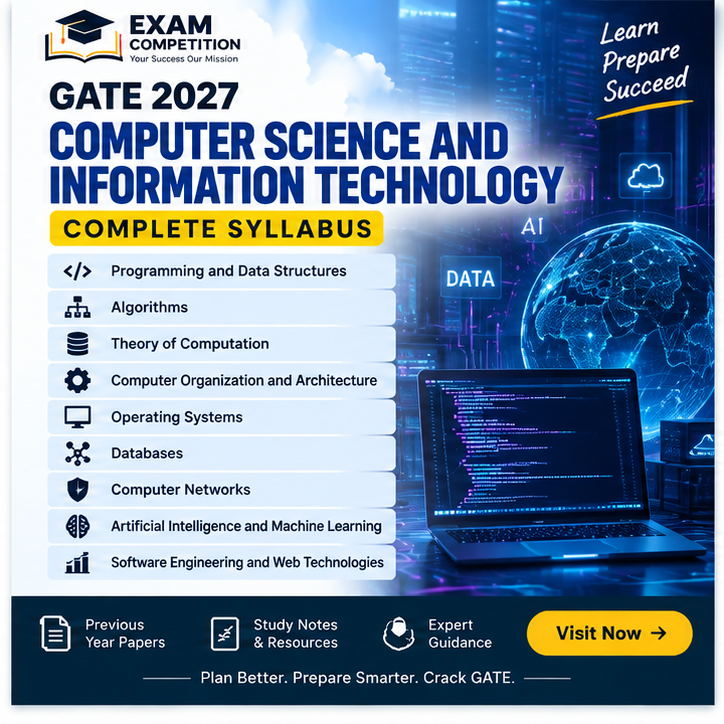
GATE Computer Science and Information Technology Syllabus 2027
The official GATE 2027 Computer Science and Information Technology (CS) syllabus covers Engineering Mathematics, Digital Logic, Computer Organization and Architecture, Programming and Data Structures, Algorithms, Theory of Computation, Compiler Design, Operating Systems, Databases and Computer Networks.
GATE CS Syllabus 2027: Overview
Computer Science and Information Technology is one of the most popular GATE papers. The syllabus combines mathematical foundations with core computer science subjects such as programming, data structures, algorithms, computer architecture, operating systems, databases, networking, compiler design and theory of computation.
Candidates preparing for GATE CS 2027 should cover every section systematically and give particular attention to conceptual understanding, algorithmic problem solving and numerical practice.
| Part | Details |
|---|---|
| Exam | Graduate Aptitude Test in Engineering (GATE) |
| Year | GATE 2027 |
| Paper Code | CS |
| Paper | Computer Science and Information Technology |
| Organizing Institute | Indian Institute of Technology Madras |
| Total Sections | 10 |
GATE 2027 CS Syllabus at a Glance
| Section | Subject | Major Areas |
|---|---|---|
| 1 | Engineering Mathematics | Discrete Mathematics, Linear Algebra, Calculus, Probability and Statistics |
| 2 | Digital Logic | Boolean Algebra, Logic Minimization, Combinational and Sequential Circuits, Number Representation and Arithmetic |
| 3 | Computer Organization and Architecture | Instruction Sets, ALU, Control Unit, Memory Hierarchy, I/O, Pipelining and Hazards |
| 4 | Programming and Data Structures | C Programming, Recursion, Arrays, Stacks, Queues, Linked Lists, Trees, Heaps and Graphs |
| 5 | Algorithms | Searching, Sorting, Hashing, Complexity, Greedy, Dynamic Programming, Divide-and-Conquer and Graph Algorithms |
| 6 | Theory of Computation | Regular Languages, Finite Automata, Context-Free Grammars, Pushdown Automata, Turing Machines and Undecidability |
| 7 | Compiler Design | Lexical Analysis, Parsing, Syntax-Directed Translation, Runtime Environments, Intermediate Code and Optimization |
| 8 | Operating Systems | Processes, Threads, IPC, Synchronization, Deadlocks, Scheduling, Memory Management, Virtual Memory and File Systems |
| 9 | Databases | ER Model, Relational Model, Relational Algebra, SQL, Normalization, Indexing, Transactions and Concurrency Control |
| 10 | Computer Networks | Layering, Switching, Data Link Layer, Ethernet, Routing, IPv4, NAT, TCP, Sockets, DNS and HTTP |
Section 1: Engineering Mathematics
Discrete Mathematics
- Propositional logic.
- First-order logic.
- Sets.
- Relations.
- Functions.
- Partial orders.
- Lattices.
- Monoids.
- Groups.
- Graphs.
- Graph connectivity.
- Matching.
- Graph colouring.
- Combinatorics.
- Counting.
- Recurrence relations.
- Generating functions.
Linear Algebra
- Matrices.
- Determinants.
- Systems of linear equations.
- Eigenvalues and eigenvectors.
- LU decomposition.
Calculus
- Limits.
- Continuity.
- Differentiability.
- Maxima and minima.
- Mean value theorem.
- Integration.
Probability and Statistics
- Random variables.
- Uniform distribution.
- Normal distribution.
- Exponential distribution.
- Poisson distribution.
- Binomial distribution.
- Mean, median and mode.
- Standard deviation.
- Conditional probability.
- Bayes theorem.
Section 2: Digital Logic
- Boolean algebra.
- Boolean function minimization using algebraic techniques.
- Karnaugh maps.
- Tabular method of minimization.
- Design of combinational circuits.
- Design of sequential circuits.
- Number representation.
- Fixed-point arithmetic.
- Floating-point arithmetic.
Section 3: Computer Organization and Architecture
- Instruction set.
- Addressing modes.
- Design of arithmetic and logic unit (ALU).
- Design of control unit.
- Hardwired control.
- Microprogrammed control.
- Memory interfacing.
- Memory hierarchy.
- Memory performance.
- Cache memory mapping.
- I/O interface.
- Interrupts.
- Direct Memory Access (DMA).
- Instruction pipelining.
- Pipeline hazards.
Section 4: Programming and Data Structures
- Programming in C.
- Recursion.
- Arrays.
- Stacks.
- Queues.
- Linked lists.
- Trees.
- Binary search trees.
- Binary heaps.
- Graphs.
Section 5: Algorithms
- Searching.
- Sorting.
- Hashing.
- Asymptotic worst-case time complexity.
- Asymptotic worst-case space complexity.
- Greedy algorithm design.
- Dynamic programming.
- Divide-and-conquer.
- Graph traversals.
- Minimum spanning trees.
- Shortest paths.
Section 6: Theory of Computation
- Regular expressions.
- Finite automata.
- Context-free grammars.
- Push-down automata.
- Regular languages.
- Context-free languages.
- Pumping lemma.
- Turing machines.
- Undecidability.
Section 7: Compiler Design
- Lexical analysis.
- Parsing.
- Syntax-directed translation.
- Runtime environments.
- Intermediate code generation.
- Local optimization.
- Data-flow analysis.
- Constant propagation.
- Liveness analysis.
- Common subexpression elimination.
Section 8: Operating Systems
- System calls.
- Processes.
- Threads.
- Inter-process communication.
- Concurrency.
- Synchronization.
- Deadlocks.
- CPU scheduling.
- I/O scheduling.
- Memory management.
- Virtual memory.
- File systems.
Section 9: Databases
- Entity-Relationship (ER) model.
- Relational model.
- Relational algebra.
- Tuple calculus.
- SQL.
- Integrity constraints.
- Normal forms.
- File organization.
- Indexing.
- B-trees and B+ trees.
- Transactions.
- Concurrency control.
Section 10: Computer Networks
- Principles of layering.
- Basics of switching.
- Circuit switching.
- Packet switching.
- Virtual circuit switching.
- Network performance metrics.
- Data link layer.
- Error detection.
- Medium Access Control (MAC).
- Ethernet.
- Distance-vector routing.
- Link-state routing.
- IPv4 fragmentation.
- CIDR notation.
- Network Address Translation (NAT).
- TCP flow control.
- TCP congestion control.
- Socket API.
- DNS.
- HTTP.
Important Topics for GATE CS 2027
| Area | Important Focus |
|---|---|
| Engineering Mathematics | Discrete mathematics, graphs, combinatorics, linear algebra, calculus, probability and statistics |
| Digital Logic | Boolean algebra, Karnaugh maps, combinational and sequential circuits, number representation |
| Computer Organization | Instruction sets, ALU, control unit, cache, memory hierarchy, I/O, pipelining and hazards |
| Programming and Data Structures | C programming, recursion, linked lists, trees, heaps and graphs |
| Algorithms | Complexity, searching, sorting, hashing, greedy, dynamic programming and graph algorithms |
| Theory of Computation | Automata, regular languages, CFGs, PDAs, pumping lemma, Turing machines and undecidability |
| Compiler Design | Lexical analysis, parsing, intermediate code, runtime environments and optimization |
| Operating Systems | Processes, threads, synchronization, deadlocks, scheduling, memory and file systems |
| Databases | ER model, relational algebra, SQL, normalization, indexing, transactions and concurrency |
| Computer Networks | Layering, switching, Ethernet, routing, IPv4, TCP, sockets, DNS and HTTP |
GATE Computer Science 2027 Preparation Strategy
1. Strengthen Discrete Mathematics
Build a strong foundation in logic, sets, relations, graphs, combinatorics, recurrence relations and mathematical reasoning.
2. Practice Programming and Algorithms
Regularly solve C programming, data structure and algorithm problems while tracking time and space complexity.
3. Master Core CS Subjects
Give dedicated revision time to Operating Systems, DBMS, Computer Networks, Computer Organization, TOC and Compiler Design.
4. Solve Previous GATE Questions
Use previous-year questions and full-length mock tests to identify recurring concepts and improve accuracy and time management.
GATE CS 2027 Exam Pattern
The official GATE 2027 question-paper pattern specifies 15 marks for General Aptitude and 85 marks for the CS subject portion. For CS and other standard engineering papers, the subject marks include Engineering Mathematics.
The examination is a three-hour computer-based test containing multiple-choice, multiple-select and numerical-answer-type questions.
Download GATE 2027 Computer Science Syllabus PDF
The official Computer Science and Information Technology syllabus PDF is available on the GATE 2027 IIT Madras website.
View Official CS Syllabus PDFSource: IIT Madras