UP PRT Syllabus 2026: Complete Subject-Wise Syllabus and Exam Pattern
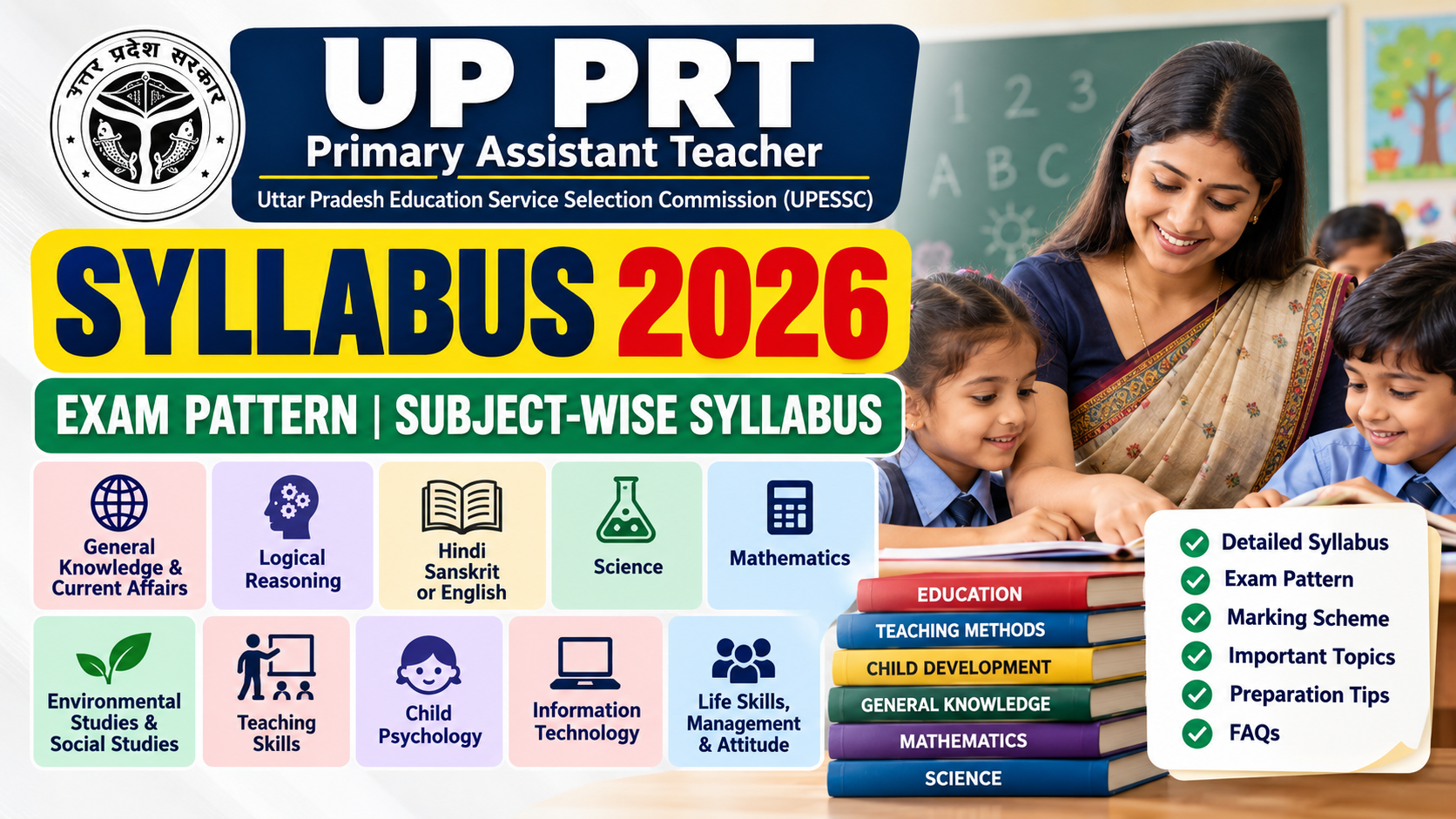
Candidates preparing for the Uttar Pradesh Primary Assistant Teacher Recruitment Examination 2026 should understand the exam pattern and subject-wise syllabus before beginning their preparation. This guide covers the reported UP PRT exam structure, marks distribution, important topics, preparation tips and official information sources.
UP PRT Syllabus 2026: Overview
| Examination | UP Primary Assistant Teacher Recruitment Examination 2026 |
|---|---|
| Conducting body | Uttar Pradesh Education Service Selection Commission (UPESSC) |
| Teaching level | Primary classes, generally Classes 1 to 5 |
| Question type | Objective-type multiple-choice questions (MCQs) |
| Total questions | 120 |
| Maximum marks | 360 |
| Reported duration | 120 minutes |
| Marks per correct answer | 3 marks |
| Reported negative marking | 1 mark deducted for an incorrect answer |
| Recruitment year | 2026 |
UP PRT Exam Pattern 2026: Subject-Wise Distribution
Published syllabus summaries report the following distribution for the Primary Assistant Teacher examination. Use this table as a preparation guide and confirm it with the official syllabus document before the examination.
| S. No. | Subject | Questions | Marks |
|---|---|---|---|
| 1 | General Knowledge and Current Affairs | 25 | 75 |
| 2 | Logical Reasoning | 5 | 15 |
| 3 | Hindi, Sanskrit or English | 30 | 90 |
| 4 | Science | 8 | 24 |
| 5 | Mathematics | 16 | 48 |
| 6 | Environmental Studies and Social Studies | 8 | 24 |
| 7 | Teaching Skills | 8 | 24 |
| 8 | Child Psychology | 8 | 24 |
| 9 | Information Technology | 4 | 12 |
| 10 | Life Skills, Management and Attitude | 8 | 24 |
| Total | 120 | 360 | |
Detailed UP PRT Syllabus 2026
1. General Knowledge and Current Affairs
This section covers general awareness, important developments and knowledge of India and Uttar Pradesh.
- Indian history and the national freedom movement
- Indian geography and world geography fundamentals
- Indian Constitution and basic political system
- Indian economy and basic economic concepts
- Uttar Pradesh history, geography and cultural heritage
- Important rivers, dams, lakes and geographical features of Uttar Pradesh
- Art, culture, festivals, fairs and traditions
- Important national and international organisations
- Government schemes and public welfare programmes
- Important national and international current affairs
- Sports, awards, books, authors and important personalities
- Science and technology developments and major national events
- Environment, biodiversity and important days
2. Logical Reasoning
Prepare basic reasoning questions that assess logical thinking, pattern recognition and problem-solving ability.
- Number series and alphabet series
- Analogy and classification
- Coding and decoding
- Odd one out
- Direction sense
- Blood relations
- Ranking and order
- Basic logical sequences
- Classification and pattern completion
- Simple statement-based reasoning
3. Language: Hindi, Sanskrit or English
The language section is reported to carry 30 questions. Candidates should carefully check the official notification for the permitted language option and the precise syllabus applicable to their examination.
Hindi
- Hindi grammar and sentence structure
- Varn, shabd and vakya fundamentals
- Sangya, sarvanam, visheshan and kriya
- Kaal, ling, vachan and karak
- Sandhi and samas
- Paryayvachi and vilom shabd
- Anekarthi shabd and shabd-yugm
- Muhavare and lokoktiyan
- Spelling and sentence correction
- Comprehension and passage-based questions
- Vocabulary and correct word usage
English
- Parts of speech
- Nouns, pronouns, adjectives and verbs
- Tenses and subject-verb agreement
- Articles, prepositions and conjunctions
- Active and passive voice
- Direct and indirect speech
- Synonyms and antonyms
- One-word substitutions and idioms
- Sentence correction and error detection
- Vocabulary and reading comprehension
Sanskrit
- Basic Sanskrit grammar
- Shabd roop and dhatu roop
- Sandhi and samas
- Vibhakti and karak
- Basic sentence construction
- Vocabulary and meaning of words
- Translation and comprehension at the prescribed level
4. Science
Revise fundamental science concepts, especially topics commonly covered in school-level science. The precise prescribed level should be confirmed from the official syllabus.
- Living and non-living things
- Plants, animals and their characteristics
- Human body and basic human physiology
- Food, nutrition and health
- Diseases, hygiene and prevention
- Materials and their properties
- States of matter and changes in matter
- Force, motion, work and energy
- Light, sound, heat and electricity fundamentals
- Natural resources and conservation
- Environment, pollution and ecosystems
- Scientific method, observation and everyday applications of science
5. Mathematics
Mathematics is reported to carry 16 questions. Build conceptual clarity and practise calculations regularly.
- Number system and place value
- Whole numbers, integers and fractions
- Decimals and comparison of numbers
- Basic arithmetic operations
- Factors, multiples, HCF and LCM
- Ratio and proportion
- Percentage and basic applications
- Average and elementary word problems
- Profit, loss and simple interest fundamentals
- Measurement of length, weight, capacity and time
- Basic geometry, lines, angles and shapes
- Perimeter, area and volume fundamentals
- Patterns and elementary algebra
- Data handling, tables and graphs
- Mathematical reasoning and everyday problem-solving
6. Environmental Studies and Social Studies
This section is reported to carry 8 questions. Focus on the relationship between people, society, the environment and everyday life.
- Family, neighbourhood and community
- Food, nutrition, water and shelter
- Plants, animals and local biodiversity
- Health, hygiene and sanitation
- Transport, communication and public services
- Natural resources and environmental conservation
- Pollution, waste management and sustainability
- Maps, directions and basic geographical concepts
- Local government and civic responsibilities
- Indian history and cultural diversity
- Basic constitutional values and citizenship
- Community life and social awareness
7. Teaching Skills
This section relates to classroom teaching, instructional planning and effective learning practices.
- Principles and objectives of teaching
- Teaching-learning process
- Lesson planning and classroom preparation
- Teaching methods and strategies
- Child-centred and activity-based learning
- Teaching-learning materials and their use
- Classroom management and discipline
- Assessment and evaluation techniques
- Remedial teaching and learning support
- Inclusive classroom practices
- Learning outcomes and competency-based education
- Communication between teachers, students and parents
8. Child Psychology
Child psychology is important for understanding the development, behaviour, learning needs and individual differences of primary school children.
- Growth and development during childhood
- Physical, cognitive, social and emotional development
- Principles and stages of child development
- Learning theories and their educational applications
- Motivation, attention and memory
- Intelligence, creativity and individual differences
- Personality and behaviour
- Learning difficulties and learner diversity
- Inclusive education and support for children with special needs
- Role of family, school and social environment
- Positive discipline and child-friendly classrooms
- Observation and understanding of student behaviour
9. Information Technology
Prepare the fundamentals of computers and digital technology used in education and daily work.
- Basic computer terminology and components
- Hardware and software
- Operating systems and file management
- Word processing, spreadsheets and presentations
- Internet, web browsers and search engines
- Email and digital communication
- Online learning resources and educational technology
- Digital safety, passwords and cybersecurity awareness
- Responsible use of digital information
- Basic computer applications in school administration
10. Life Skills, Management and Attitude
This section focuses on professional behaviour, interpersonal skills, decision-making and effective management.
- Communication and interpersonal skills
- Teamwork and cooperation
- Leadership and responsibility
- Time management and prioritisation
- Problem-solving and decision-making
- Critical thinking and creativity
- Emotional intelligence and self-awareness
- Stress management and adaptability
- Ethics, integrity and professional conduct
- Conflict resolution and classroom relationships
- School management and organisational skills
- Positive attitude towards students and learning
UP PRT Marking Scheme 2026
| Response | Reported marks |
|---|---|
| Correct answer | +3 |
| Incorrect answer | -1 |
| 120 correct answers | 360 marks |
Negative marking can affect the final score. Avoid random guessing and verify the rules for unanswered questions, multiple responses and any other special cases in the official examination instructions.
How to Prepare for UP PRT 2026
- Read the official syllabus first: Separate confirmed topics from general practice topics.
- Prioritise high-weightage sections: General Knowledge and Current Affairs, language and Mathematics account for a substantial portion of the reported paper.
- Practise teaching-related subjects: Study child development, classroom management, teaching methods and assessment.
- Revise school-level concepts: Strengthen basic Mathematics, Science, Environmental Studies and Social Studies.
- Study Uttar Pradesh general knowledge: Cover state history, geography, culture, administration and current affairs.
- Practise timed MCQs: Use mock tests to improve accuracy and manage the 120-minute time limit.
- Review mistakes: Maintain a notebook of incorrect answers and revise the underlying concepts.
- Check official updates: Follow UPESSC notices for any revised syllabus, examination instructions or changes in the pattern.
Suggested 30-Day Revision Plan
| Period | Study focus |
|---|---|
| Days 1–7 | Language, Mathematics and core school-level concepts |
| Days 8–14 | General Knowledge, Uttar Pradesh GK and Current Affairs |
| Days 15–21 | Teaching Skills, Child Psychology, EVS and Science |
| Days 22–26 | Reasoning, Information Technology, Life Skills and weak topics |
| Days 27–30 | Full-length mock tests, revision and error analysis |
This is a suggested revision schedule, not an official timetable. Adjust it according to your preparation level and the time remaining before the examination.
UP PRT Syllabus 2026: Frequently Asked Questions
1. How many questions are in the UP PRT 2026 examination?
Published syllabus summaries report 120 objective questions carrying a total of 360 marks. Confirm the final structure in the applicable official notification.
2. What is the reported duration of the UP PRT exam?
The reported duration is 120 minutes. Candidates should check their official examination instructions for the confirmed duration and any additional instructions.
3. Is there negative marking in UP PRT 2026?
Published 2026 syllabus summaries report a deduction of one mark for an incorrect answer. Verify this rule in the official notification before the examination.
4. Which subjects should candidates study?
The reported syllabus includes General Knowledge and Current Affairs, Logical Reasoning, a language section, Science, Mathematics, Environmental Studies and Social Studies, Teaching Skills, Child Psychology, Information Technology, and Life Skills, Management and Attitude.
5. Is UP PRT the same as UPTET Paper 1?
No. UP PRT refers to primary teacher recruitment, whereas UPTET Paper 1 is a teacher eligibility test for the primary level. Their purposes, examination structures and syllabuses may differ.
6. Where can candidates find the official UP PRT syllabus?
Candidates should visit the official Uttar Pradesh Education Service Selection Commission website and check the relevant Primary Assistant Teacher Recruitment 2026 advertisement, syllabus document and examination notices.
Official Website and Further Updates
For the latest recruitment instructions and official documents, visit:
Use the official recruitment advertisement and syllabus PDF as the final authority for the exam pattern, syllabus, marking scheme and other examination rules.
Disclaimer: This article is intended as a study guide. The detailed topic lists include preparation areas and should not be treated as a verbatim reproduction of an official syllabus. Recruitment rules and examination details can change; candidates should verify them through official UPESSC publications.
Source: Uttar Pradesh Education Service Selection Commission (UPESSC)