GATE Data Science and Artificial Intelligence Syllabus 2027: Complete DA Syllabus and Topics
GATE Data Science and Artificial Intelligence Syllabus 2027
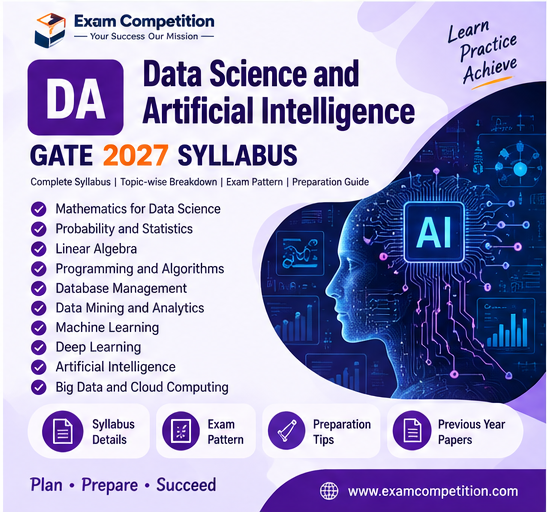
The official GATE 2027 Data Science and Artificial Intelligence (DA) syllabus covers seven sections: Probability and Statistics, Linear Algebra, Calculus and Optimization, Programming and Data Structures, Database Management and Warehousing, Machine Learning, and Artificial Intelligence.
GATE DA Syllabus 2027: Overview
Data Science and Artificial Intelligence is a dedicated GATE paper that combines mathematical foundations, programming, algorithms, database systems, machine learning and artificial intelligence.
The DA syllabus places strong emphasis on probability and statistics, linear algebra, optimization, Python programming, fundamental data structures and algorithms, database management, supervised and unsupervised learning, and AI reasoning and search techniques.
| Part | Details |
|---|---|
| Exam | Graduate Aptitude Test in Engineering (GATE) |
| Year | GATE 2027 |
| Paper Code | DA |
| Paper | Data Science and Artificial Intelligence |
| Organizing Institute | Indian Institute of Technology Madras |
| Total Sections | 7 |
GATE 2027 DA Syllabus at a Glance
| Section | Subject | Major Areas |
|---|---|---|
| 1 | Probability and Statistics | Probability, random variables, distributions, conditional probability, Bayes theorem, estimation, confidence intervals and hypothesis testing |
| 2 | Linear Algebra | Vector spaces, matrices, linear systems, eigenvalues, eigenvectors, rank, LU decomposition and SVD |
| 3 | Calculus and Optimization | Limits, continuity, differentiability, Taylor series, maxima, minima and single-variable optimization |
| 4 | Programming, Data Structures and Algorithms | Python, stacks, queues, linked lists, trees, hash tables, searching, sorting, divide-and-conquer and graph algorithms |
| 5 | Database Management and Warehousing | ER model, relational algebra, SQL, normalization, indexing, data transformation and data warehouse modelling |
| 6 | Machine Learning | Regression, classification, KNN, Naive Bayes, LDA, SVM, decision trees, neural networks, clustering and PCA |
| 7 | Artificial Intelligence | Search, logic, reasoning under uncertainty, exact inference and approximate inference |
Section 1: Probability and Statistics
- Counting: permutations and combinations.
- Probability axioms.
- Sample space and events.
- Independent events.
- Mutually exclusive events.
- Marginal probability.
- Conditional probability.
- Joint probability.
- Bayes theorem.
- Conditional expectation.
- Conditional variance.
- Mean, median, mode and standard deviation.
- Correlation and covariance.
- Random variables.
- Discrete random variables and probability mass functions.
- Uniform distribution.
- Bernoulli distribution.
- Binomial distribution.
- Continuous random variables and probability distribution functions.
- Continuous uniform distribution.
- Exponential distribution.
- Poisson distribution.
- Normal distribution.
- Standard normal distribution.
- t-distribution.
- Chi-squared distribution.
- Cumulative distribution function.
- Conditional probability density functions.
- Central Limit Theorem.
- Confidence intervals.
- z-test.
- t-test.
- Chi-squared test.
Section 2: Linear Algebra
- Vector spaces.
- Subspaces.
- Linear dependence and independence of vectors.
- Matrices.
- Projection matrices.
- Orthogonal matrices.
- Idempotent matrices.
- Partition matrices and their properties.
- Quadratic forms.
- Systems of linear equations and their solutions.
- Gaussian elimination.
- Eigenvalues and eigenvectors.
- Determinants.
- Rank and nullity.
- Projections.
- LU decomposition.
- Singular Value Decomposition (SVD).
Section 3: Calculus and Optimization
- Functions of a single variable.
- Limits.
- Continuity.
- Differentiability.
- Taylor series.
- Maxima and minima.
- Optimization involving a single variable.
Section 4: Programming, Data Structures and Algorithms
Programming and Data Structures
- Programming in Python.
- Stacks.
- Queues.
- Linked lists.
- Trees.
- Hash tables.
Searching and Sorting
- Linear search.
- Binary search.
- Selection sort.
- Bubble sort.
- Insertion sort.
Divide and Conquer
- Merge sort.
- Quick sort.
Graph Algorithms
- Introduction to graph theory.
- Graph traversals.
- Shortest path algorithms.
Section 5: Database Management and Warehousing
Database Management
- Entity-Relationship (ER) model.
- Relational model.
- Relational algebra.
- Tuple calculus.
- SQL.
- Integrity constraints.
- Normal forms.
- File organization.
- Indexing.
Data Transformation
- Normalization.
- Discretization.
- Sampling.
- Compression.
- Data types.
Data Warehousing
- Data warehouse modelling.
- Schemas for multidimensional data models.
- Concept hierarchies.
- Measures.
- Categorization of measures.
- Computation of measures.
Section 6: Machine Learning
Supervised Learning
- Regression problems.
- Classification problems.
- Simple linear regression.
- Multiple linear regression.
- Ridge regression.
- Logistic regression.
- K-nearest neighbour.
- Naive Bayes classifier.
- Linear Discriminant Analysis (LDA).
- Support Vector Machine (SVM).
- Decision trees.
- Bias-variance trade-off.
- Cross-validation methods.
- Leave-One-Out (LOO) cross-validation.
- K-fold cross-validation.
- Multi-layer perceptron.
- Feed-forward neural networks.
Unsupervised Learning
- Clustering algorithms.
- K-means clustering.
- K-medoid clustering.
- Hierarchical clustering.
- Top-down hierarchical clustering.
- Bottom-up hierarchical clustering.
- Single-linkage clustering.
- Multiple-linkage clustering.
- Dimensionality reduction.
- Principal Component Analysis (PCA).
Section 7: Artificial Intelligence
Search
- Informed search.
- Uninformed search.
- Adversarial search.
Logic
- Propositional logic.
- Predicate logic.
Reasoning Under Uncertainty
- Conditional independence representation.
- Exact inference through variable elimination.
- Approximate inference through sampling.
Important Topics for GATE DA 2027
| Area | Important Focus |
|---|---|
| Probability and Statistics | Probability axioms, Bayes theorem, distributions, random variables, CLT, confidence intervals and statistical tests |
| Linear Algebra | Vector spaces, matrices, eigenvalues, eigenvectors, rank, LU decomposition and SVD |
| Calculus and Optimization | Limits, continuity, differentiability, Taylor series, maxima, minima and single-variable optimization |
| Python and Data Structures | Python programming, stacks, queues, linked lists, trees and hash tables |
| Algorithms | Searching, sorting, merge sort, quick sort, graph traversal and shortest paths |
| Databases | ER model, relational algebra, tuple calculus, SQL, normalization, indexing and data transformation |
| Data Warehousing | Multidimensional models, schemas, concept hierarchies and measures |
| Supervised Learning | Regression, classification, KNN, Naive Bayes, LDA, SVM, decision trees and neural networks |
| Unsupervised Learning | K-means, K-medoid, hierarchical clustering and PCA |
| Artificial Intelligence | Informed, uninformed and adversarial search, logic and probabilistic inference |
GATE Data Science and AI 2027 Preparation Strategy
1. Strengthen Probability and Linear Algebra
Probability, statistics and linear algebra form the mathematical foundation for machine learning. Practice numerical problems alongside theory.
2. Practice Python Regularly
Develop fluency with Python and understand the implementation and behaviour of the data structures and algorithms included in the syllabus.
3. Master Machine Learning Concepts
Focus on regression, classification, model evaluation, clustering and dimensionality reduction. Understand the mathematical reasoning behind each method.
4. Revise AI and Databases
Prepare search strategies, logic, probabilistic inference, SQL, relational algebra, normalization and data warehouse concepts.
GATE DA 2027 Exam Pattern
The official GATE 2027 pattern allocates 15 marks to General Aptitude and 85 marks to the DA subject portion. Unlike the standard engineering papers where Engineering Mathematics is separately identified within the subject marks, DA is listed among the papers carrying the full 85 subject marks.
The examination is a three-hour computer-based test with MCQ, MSQ and NAT questions.
Download GATE 2027 Data Science and Artificial Intelligence Syllabus PDF
The official DA syllabus PDF is available on the GATE 2027 IIT Madras website.
View Official DA Syllabus PDFSource: IIT Madras