GATE Electronics and Communication Engineering Syllabus 2027: Complete EC Syllabus and Topics
GATE Electronics and Communication Engineering Syllabus 2027
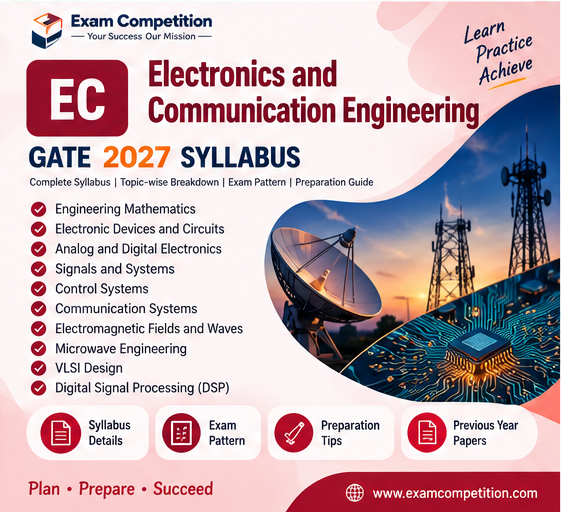
The official GATE 2027 Electronics and Communication Engineering (EC) syllabus consists of eight sections covering Engineering Mathematics, Networks, Signals and Systems, Electronic Devices, Analog Circuits, Digital Circuits, Control Systems, Communications and Electromagnetics.
GATE EC Syllabus 2027: Overview
Electronics and Communication Engineering is one of the core GATE test papers. The EC syllabus combines mathematical foundations with electrical network analysis, signals and systems, semiconductor devices, analog and digital electronics, control systems, communication engineering and electromagnetics.
Candidates preparing for GATE EC 2027 should study the concepts systematically and solve numerical and conceptual questions alongside their theory preparation.
| Part | Details |
|---|---|
| Exam | Graduate Aptitude Test in Engineering (GATE) |
| Year | GATE 2027 |
| Paper Code | EC |
| Paper | Electronics and Communication Engineering |
| Organizing Institute | Indian Institute of Technology Madras |
| Total Syllabus Sections | 8 |
| Subject Marks | 85 marks including Engineering Mathematics |
GATE 2027 EC Syllabus at a Glance
| Section | Subject | Major Areas |
|---|---|---|
| 1 | Engineering Mathematics | Linear algebra, calculus, differential equations, vector analysis, complex analysis, probability and statistics |
| 2 | Networks, Signals and Systems | Circuit analysis, sinusoidal steady state, LTI systems, Fourier analysis, sampling, DTFT, DFT, z-transform and digital filters |
| 3 | Electronic Devices | Semiconductor physics, carrier transport, PN junction, Zener diode, BJT, MOS capacitor, MOSFET, LED, photodiode and solar cell |
| 4 | Analog Circuits | Diode circuits, BJT and MOSFET amplifiers, current mirrors, differential amplifiers and op-amp circuits |
| 5 | Digital Circuits | Number representation, Boolean algebra, combinational and sequential circuits, data converters, memories and computer organization |
| 6 | Control Systems | Feedback, transfer functions, block diagrams, stability, Bode plots, root locus, compensators, PID and state-space models |
| 7 | Communications | Random processes, analog and digital communications, information theory, digital modulation, detection and error correction |
| 8 | Electromagnetics | Maxwell equations, plane waves, transmission lines, waveguides, optical fibers and antennas |
Section 1: Engineering Mathematics
Linear Algebra
- Vector spaces.
- Basis.
- Linear dependence and independence.
- Matrix algebra.
- Eigenvalues and eigenvectors.
- Rank.
- Solution of linear equations.
- Existence and uniqueness of solutions.
Calculus
- Mean value theorems.
- Theorems of integral calculus.
- Evaluation of definite and improper integrals.
- Partial derivatives.
- Maxima and minima.
- Multiple integrals.
- Line, surface and volume integrals.
- Taylor series.
Differential Equations
- Linear differential equations.
- Euler-Cauchy equation.
- Nonhomogeneous equations.
- Variation of parameters.
- Complementary function and particular integral.
- Partial differential equations.
- Variable separable method.
- Initial and boundary value problems.
Vector Analysis
- Vectors in plane and space.
- Vector operations.
- Gradient.
- Divergence.
- Curl.
- Gauss theorem.
- Green theorem.
- Stokes theorem.
Complex Analysis
- Analytic functions.
- Cauchy integral theorem.
- Cauchy integral formula.
- Sequences and series.
- Convergence tests.
- Taylor series.
- Laurent series.
- Residue theorem.
Probability and Statistics
- Mean, median and mode.
- Standard deviation.
- Combinatorial probability.
- Probability distributions.
- Binomial distribution.
- Poisson distribution.
- Exponential distribution.
- Normal distribution.
- Joint and conditional probability.
- Correlation and regression analysis.
Section 2: Networks, Signals and Systems
Circuit Analysis
- Node and mesh analysis.
- Superposition theorem.
- Thevenin theorem.
- Norton theorem.
- Reciprocity.
Sinusoidal Steady State Analysis
- Phasors.
- Complex power.
- Maximum power transfer.
Time and Frequency Domain Analysis
- RL circuits.
- RC circuits.
- RLC circuits.
- Solution of network equations using Laplace transform.
- Linear two-port network parameters.
- Wye-delta transformation.
LTI Systems
- Definition and properties.
- Causality.
- Stability.
- Impulse response.
- Convolution.
- Poles and zeroes.
- Frequency response.
- Group delay.
- Phase delay.
Continuous-Time Signals
- Fourier series.
- Fourier transform.
- Nyquist sampling theorem.
- Sampling and reconstruction.
Discrete-Time Signals
- DTFT.
- DFT.
- Z-transform.
- FIR filter design.
- IIR filter design.
Section 3: Electronic Devices
- Formation of energy bands in solids.
- Energy bands in intrinsic and extrinsic semiconductors.
- Equilibrium carrier concentration.
- Direct and indirect band-gap semiconductors.
- Diffusion current.
- Drift current.
- Mobility and resistivity.
- Generation and recombination of carriers.
- Poisson equation.
- Continuity equation.
- P-N junction.
- Zener diode.
- BJT.
- MOS capacitor.
- MOSFET.
- Scaling in MOSFETs.
- LED.
- Photodiode.
- Solar cell.
Section 4: Analog Circuits
Diode Circuits
- Clipping circuits.
- Clamping circuits.
- Rectifiers.
BJT and MOSFET Amplifiers
- Biasing.
- AC coupling.
- Small signal analysis.
- Frequency response.
- Current mirrors.
- Differential amplifiers.
Op-Amp Circuits
- Amplifiers.
- Summers.
- Differentiators.
- Integrators.
- Active filters.
- Schmitt trigger.
- Oscillators.
- Dominant-pole (Miller) compensation.
- Phase margin.
Section 5: Digital Circuits
Number Representations and Combinatorial Circuits
- Binary numbers.
- Integer numbers.
- Floating-point numbers.
- Boolean algebra.
- Minimization using Boolean identities.
- Karnaugh maps.
- Logic gates.
- Static CMOS implementations.
- Arithmetic circuits.
- Code converters.
- Multiplexers.
- Decoders.
Sequential Circuits
- Latches and flip-flops.
- Counters.
- Shift registers.
- Finite state machines.
- Propagation delay.
- Setup and hold time.
- Critical path delay.
Data Converters
- Sample and hold circuits.
- Analog-to-digital converters (ADCs).
- Digital-to-analog converters (DACs).
Semiconductor Memories
- ROM.
- SRAM.
- DRAM.
Computer Organization
- Machine instructions.
- Addressing modes.
- ALU.
- Data path.
- Control unit.
- Instruction pipelining.
Section 6: Control Systems
- Basic control system components.
- Feedback principle.
- Transfer function.
- Block diagram representation.
- Signal flow graph.
- Transient and steady-state analysis of LTI systems.
- Frequency response.
- Routh-Hurwitz stability criterion.
- Nyquist stability criterion.
- Bode plots.
- Root-locus plots.
- Compensators.
- PID controller.
- State variable model.
- Solution of state equation of LTI systems.
Section 7: Communications
Random Processes
- Autocorrelation.
- Power spectral density.
- Properties of white noise.
- Filtering of random signals through LTI systems.
Analog Communications
- Amplitude modulation and demodulation.
- Angle modulation and demodulation.
- Spectra of AM and FM.
- Superheterodyne receivers.
Information Theory
- Entropy.
- Source coding.
- Mutual information.
- Channel capacity theorem.
Digital Communications
- PCM.
- DPCM.
- ASK.
- PSK.
- FSK.
- QAM.
- Bandwidth.
- Inter-symbol interference.
- MAP detection.
- ML detection.
- Matched filter receiver.
- SNR and BER.
- Fundamentals of error correction.
- Hamming codes.
- CRC.
Section 8: Electromagnetics
Maxwell's Equations
- Differential forms of Maxwell's equations.
- Integral forms of Maxwell's equations.
- Interpretation of Maxwell's equations.
- Boundary conditions.
- Wave equation.
- Poynting vector.
Plane Waves and Properties
- Reflection.
- Refraction.
- Polarization.
- Phase velocity.
- Group velocity.
- Propagation through various media.
- Skin depth.
Transmission Lines and Waveguides
- Transmission line equations.
- Characteristic impedance.
- Impedance matching.
- Impedance transformation.
- S-parameters.
- Smith chart.
- Rectangular waveguides.
- Circular waveguides.
Optical Fibers and Antennas
- Light propagation through optical fibers.
- Dipole antennas.
- Monopole antennas.
- Linear antenna arrays.
Important Topics for GATE EC 2027
| Area | Important Focus |
|---|---|
| Engineering Mathematics | Linear algebra, calculus, differential equations, vector analysis, complex analysis, probability and statistics |
| Networks | Node and mesh analysis, network theorems, sinusoidal steady state, two-port networks and Laplace transform |
| Signals and Systems | LTI systems, convolution, poles and zeroes, Fourier analysis, sampling, DTFT, DFT, z-transform and filters |
| Electronic Devices | Semiconductors, carrier transport, PN junction, BJT, MOSFET, LED, photodiode and solar cell |
| Analog Circuits | Diode circuits, transistor amplifiers, current mirrors, differential amplifiers and op-amp circuits |
| Digital Circuits | Boolean algebra, Karnaugh maps, logic gates, sequential circuits, ADC/DAC, memories and computer organization |
| Control Systems | Transfer functions, stability criteria, Bode plots, root locus, compensators, PID and state-space analysis |
| Communications | Random processes, AM/FM, information theory, digital modulation, detection, SNR, BER and error correction |
| Electromagnetics | Maxwell equations, plane waves, transmission lines, Smith chart, waveguides, optical fibers and antennas |
GATE Electronics and Communication Engineering Preparation Strategy
1. Build the Mathematical Foundation
Revise linear algebra, calculus, differential equations, complex analysis, vector analysis and probability before moving deeply into the technical subjects.
2. Master Circuit and Signal Analysis
Practice network theorems, circuit analysis, Laplace transforms, Fourier analysis, sampling and LTI-system problems regularly.
3. Strengthen Electronics
Focus on semiconductor devices, transistor models, amplifiers, op-amps, digital logic, sequential circuits, memories and data converters.
4. Practise Control and Communication
Solve problems involving stability, frequency response, modulation, detection, information theory, error correction and communication systems.
5. Revise Electromagnetics
Pay attention to Maxwell equations, wave propagation, transmission lines, impedance matching, Smith charts, waveguides and antennas.
6. Solve Previous GATE Questions
After completing each topic, solve previous GATE questions and use timed practice to improve calculation speed and accuracy.
GATE EC 2027 Exam Pattern
The GATE 2027 EC paper carries 100 marks in total. General Aptitude accounts for 15 marks and the selected subject accounts for 85 marks. For EC, the subject marks include Engineering Mathematics, which is listed as a paper-specific component.
The examination is a three-hour Computer Based Test. Questions can be Multiple Choice Questions (MCQ), Multiple Select Questions (MSQ) or Numerical Answer Type (NAT).
Download GATE 2027 Electronics and Communication Engineering Syllabus PDF
The complete official EC syllabus is available in the GATE 2027 syllabus document issued by IIT Madras.
View Official EC Syllabus PDFSource: IIT Madras