GATE Environmental Science and Engineering Syllabus 2027: Complete ES Syllabus and Topics
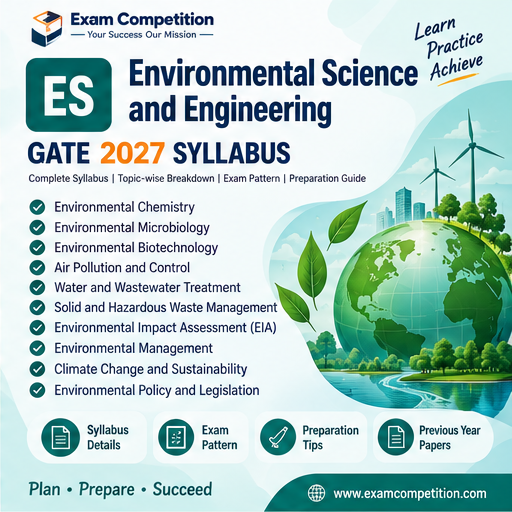
GATE Environmental Science and Engineering Syllabus 2027
The official GATE 2027 Environmental Science and Engineering (ES) syllabus covers nine major sections, ranging from mathematics and environmental chemistry to water resources, pollution control, waste management, environmental policy and sustainable development.
GATE ES Syllabus 2027: Overview
Environmental Science and Engineering is a multidisciplinary GATE paper combining mathematical foundations with chemistry, microbiology, hydrology, hydraulics, water and wastewater treatment, air pollution control, solid and hazardous waste management, environmental management and sustainability.
The GATE 2027 ES syllabus also gives considerable importance to current environmental challenges, including climate change, biodiversity, greenhouse gases, waste-to-energy, circular economy, environmental law and sustainable development.
| Part | Details |
|---|---|
| Exam | Graduate Aptitude Test in Engineering (GATE) |
| Year | GATE 2027 |
| Paper Code | ES |
| Paper | Environmental Science and Engineering |
| Organizing Institute | Indian Institute of Technology Madras |
| Total Syllabus Sections | 9 |
| General Aptitude | 15 marks |
| ES Subject | 85 marks |
GATE 2027 ES Syllabus at a Glance
| Section | Subject | Major Areas |
|---|---|---|
| 1 | Mathematics Foundation | Linear algebra, calculus, numerical methods, probability and statistics |
| 2 | Environmental Chemistry | Environmental chemistry, water chemistry, soil chemistry and atmospheric chemistry |
| 3 | Environmental Microbiology | Microorganisms, cell biology, metabolism, microbial growth, health and microbial control |
| 4 | Water Resources and Environmental Hydraulics | Water resources, hydrological cycle, surface water, groundwater, fluid mechanics and channel hydraulics |
| 5 | Water and Wastewater Treatment and Management | Water quality, treatment, sewage systems, wastewater treatment, industrial effluents and reactor design |
| 6 | Air and Noise Pollution | Air pollutants, particulate and gaseous pollutant control, air quality management, dispersion and noise pollution |
| 7 | Solid and Hazardous Waste Management | Municipal solid waste, hazardous waste, biomedical waste, plastic waste, C&D waste, e-waste and circular economy |
| 8 | Global and Regional Environmental Issues | Climate change, greenhouse gases, global warming, acid rain, ozone depletion, ecosystems and biodiversity |
| 9 | Environmental Management and Sustainable Development | Environmental management systems, EIA, LCA, environmental law, energy-environment nexus, SDGs and ESG |
Section 1: Mathematics Foundation
Linear Algebra
- Determinants and matrices.
- Systems of linear equations.
- Eigenvalues and eigenvectors.
Calculus
- Functions.
- Limits.
- Continuity.
- Differentiability.
- Local maxima and minima.
- Taylor series.
- Tests for convergence.
- Definite and indefinite integrals.
- Applications of definite integrals to obtain area and volume.
- Partial and total derivatives.
- Linear and non-linear first-order ordinary differential equations.
Numerical Methods
- Approximation, errors, accuracy and precision.
- Numerical solutions of linear and non-linear algebraic equations.
- Interpolation and curve fitting.
- Least-square approximation.
- Newton's and Lagrange polynomials.
- Numerical differentiation and integration.
- Trapezoidal rule.
- Simpson's rule.
- Numerical solution of ordinary differential equations.
- Single-step and multi-step methods.
Probability and Statistics
- Descriptive statistics.
- Measures of central tendency.
- Dispersion.
- Skewness and kurtosis.
- Probability concepts.
- Conditional probability.
- Bayes theorem.
- Risk and reliability.
- Probability distributions.
- Correlation.
- Single and multiple regression models.
- Hypothesis testing using t-test, F-test and chi-square test.
Section 2: Environmental Chemistry
Fundamentals of Environmental Chemistry
- Covalent and ionic bonding.
- Chemical equations.
- Concentration and activity.
- Structure and chemistry of organic molecules.
- Chemical equilibria.
- Thermodynamics and kinetics of chemical reactions.
Principles of Water Chemistry
- Water quality parameters and their measurement.
- Acid-base equilibria.
- Buffer solutions.
- Carbonate equilibrium.
- Solubility of gases in water.
- Complexation.
- Precipitation reactions.
- Redox reactions.
- Inorganic and organic contaminants.
Soil Chemistry
- Organic matter.
- Nitrogen.
- Phosphorous.
- Potassium.
- Cation exchange capacity.
- Base saturation.
- Sodium absorption ratio.
Atmospheric Chemistry
- Composition of the atmosphere.
- Reactivity of trace substances in the atmosphere.
- Chemistry of ozone formation.
Section 3: Environmental Microbiology
Prokaryotic and Eukaryotic Microorganisms
- Characteristics of diverse groups of microorganisms.
- Classification of microorganisms.
- Microbial diversity.
- Role of microorganisms in wastewater treatment.
- Role of microorganisms in bioremediation.
- Role of microorganisms in biogeochemical cycling.
Cell Chemistry and Cell Biology
- Structure of proteins.
- Nucleic acids including DNA and RNA.
- Lipids.
- Polysaccharides.
- Structure of cells.
- Cytoplasmic membrane.
- Cell wall.
- Outer membrane.
- Glycocalyx.
- Antimicrobial resistance.
- Quorum sensing.
Microbial Metabolism
- Anabolism and catabolism.
- Phosphorylation.
- Glycolysis.
- TCA cycle.
- Electron transport chain.
- Fermentation.
- Anaerobic respiration.
- Energy balances.
- Enzymes and enzyme kinetics.
Growth and Control of Microorganisms
- Bacterial nutrition and growth.
- Specific growth rate and doubling time.
- Monod's model.
- Types of culture media.
- Batch and continuous culture.
- Effects of environmental factors on growth.
- Physical and chemical methods of microbial control.
Microbiology and Health
- Pathogens and modes of transmission.
- Indicator organisms.
- Quantification of coliforms using MPN.
- Membrane filtration techniques.
Section 4: Water Resources and Environmental Hydraulics
Global Water Resources
- Structure, properties and distribution of water.
- Threats to water resources.
- Water conservation.
Surface Water Resources
- Hydrological cycle.
- Water balance.
- Precipitation.
- Infiltration.
- Evapotranspiration.
- Runoff.
- Flow hydrographs.
- Unit hydrographs.
- Stage-discharge relationship.
- Reservoir capacity.
- Surface water management.
- Rainwater harvesting and storage.
Groundwater Resources
- Geologic formations as aquifers.
- Vadose and saturated zones.
- Confined and unconfined aquifers.
- Porosity.
- Permeability.
- Transmissivity.
- Storage coefficient.
- Darcy's law and applications.
- Steady-state well hydraulics.
Environmental Hydraulics
- Concepts of mechanics.
- Properties of fluids.
- Pressure measurement.
- Hydrostatic force on surfaces.
- Buoyancy and flotation.
- Laminar and turbulent flow.
- Flow through pipes.
- Pipe networks.
- Forces on immersed bodies.
- Flow measurement in channels and pipes.
- Kinematics of flow.
- Continuity, momentum and energy equations.
- Channel hydraulics.
- Specific energy.
- Critical flow.
- Hydraulic jump.
- Rapid and gradually varied flow.
- Design of lined channels.
Section 5: Water and Wastewater Treatment and Management
Water Quality and Pollution
- Water and wastewater quality parameters.
- Eutrophication.
- Thermal stratification in lakes.
- River pollution.
- Oxygen sag curve.
Water Treatment
- Screening.
- Sedimentation with and without coagulation.
- Filtration.
- Desalination.
- Disinfection.
- Water distribution and storage.
Wastewater Collection and Treatment
- Point and non-point sources of wastewater.
- Population forecasting methods.
- Design of sewer systems.
- Design of storm-water sewers.
- Sewer appurtenances.
- Preliminary sewage treatment.
- Primary sewage treatment.
- Secondary sewage treatment.
- Tertiary sewage treatment.
- Sludge generation, processing and disposal.
- Sewage farming.
Industrial Wastewater and Reactor Design
- Sources and characteristics of industrial effluents.
- Common Effluent Treatment Plants (CETP).
- Wastewater recycling.
- Zero liquid discharge.
- Mass and energy balance.
- Order and rate of reactions.
- Batch reactors.
- Completely mixed flow reactors.
- Plug flow reactors.
Section 6: Air and Noise Pollution
Air Pollution Fundamentals
- Structure and composition of the atmosphere.
- Natural and anthropogenic sources.
- Emission, transformation, transport and removal processes.
- Indoor air pollution.
- Effects on health and environment.
- Gaseous pollutants and particulate matter.
- Air quality standards.
- Primary and secondary pollutants.
- Criteria pollutants.
- Ambient and emission standards.
- Air quality indices.
- Visibility and radiative effects.
Particulate Pollutants
- Measurement methods.
- Control methods.
- Gravitational settling chambers.
- Cyclone separators.
- Wet scrubbers.
- Fabric filters and baghouse filters.
- Electrostatic precipitators (ESP).
Gaseous Pollutants
- Measurement and control methods.
- Absorption.
- Adsorption.
- Condensation.
- Combustion.
- Control of sulphur oxides.
- Control of nitrogen oxides.
- Control of carbon monoxide.
- Control of hydrocarbons.
- Diffusion.
- Fick's law.
- Interfacial mass transfer.
- Vehicular emission control systems.
- Diesel particulate filters.
- Catalytic converters.
- Fuel standards.
Air Quality Management
- Point, line and area sources.
- Emission inventory.
- Meteorology and dispersion.
- Atmospheric stability and inversion.
- Mixing height.
- Wind rose diagrams.
- Gaussian plume dispersion modelling.
- Topographic influences.
Noise Pollution
- Sources of noise.
- Health effects.
- Noise standards.
- Sound pressure level.
- Equivalent continuous sound level (Leq).
- Day-night level (Ldn).
- Frequency analysis.
- Noise control and mitigation methods.
Section 7: Solid and Hazardous Waste Management
Integrated Solid Waste Management
- Integrated solid waste management.
- Waste hierarchy.
- Rules and regulations for solid waste management in India.
Municipal Solid Waste Management
- Sources and generation.
- Waste characteristics.
- Collection.
- Segregation.
- Transportation.
- Waste processing and disposal.
- Reuse options.
- Biological methods.
- Energy recovery processes.
- Landfilling.
- Waste-to-energy technologies.
- Circular economy principles.
- Life-cycle energy analysis.
- Decentralized renewable systems.
- Urban metabolism.
Hazardous and Special Waste
- Characteristics of hazardous waste.
- Hazardous waste generation.
- Fate of materials in the environment.
- Treatment and disposal.
- Soil contamination.
- Leaching of contaminants into groundwater.
- Biomedical waste management.
- Plastic waste management.
- Waste from the energy sector including solar, wind and batteries.
- Construction and demolition waste.
- E-waste.
- Storage, collection and transfer practices.
Section 8: Global and Regional Environmental Issues
Global Environmental Effects
- Greenhouse gases.
- Radiative forcing.
- Global warming potential (GWP).
- Climate change.
- Urban heat islands.
- Acid rain.
- Ozone hole.
Ecology and Environmental Degradation
- Ecology.
- Various ecosystems.
- Biodiversity.
- Factors influencing population increase.
- Energy consumption.
- Environmental degradation.
Section 9: Environmental Management and Sustainable Development
Environmental Management
- Environmental Management Systems.
- ISO 14000 series.
- Environmental auditing.
- Environmental Impact Assessment (EIA).
- Life Cycle Assessment (LCA).
- Human health risk assessment.
- Occupational health and hygiene.
- Physical and chemical hazards.
Environmental Law and Policy
- Objectives of environmental law and policy.
- Polluter pays principle.
- Precautionary principle.
- Water and Air Acts with amendments.
- Environment (Protection) Act, 1986.
- National Green Tribunal Act, 2010.
- National Environment Policy.
- Principles of international law.
- International treaties.
Energy and Environment
- Energy resources.
- Resources and reserves.
- Renewable energy sources.
- Non-renewable energy sources.
- Energy-environment nexus.
Sustainable Development
- Definition and concepts of sustainable development.
- Sustainable Development Goals (SDGs).
- Hurdles to sustainability.
- Environment and economics.
- Carbon pricing.
- Emission trading.
- Environmental, Social and Governance (ESG) frameworks.
Important Topics for GATE ES 2027
| Area | Important Focus |
|---|---|
| Mathematics | Linear algebra, calculus, numerical methods, probability, statistics, regression and hypothesis testing |
| Environmental Chemistry | Water chemistry, chemical equilibrium, contaminants, soil chemistry and atmospheric chemistry |
| Environmental Microbiology | Microbial diversity, cell biology, metabolism, growth kinetics, wastewater microbiology and pathogens |
| Water Resources | Hydrological cycle, surface water, groundwater, Darcy's law, hydraulics and channel flow |
| Water and Wastewater | Water treatment, sewage treatment, sludge, industrial effluents, CETP, recycling and reactor design |
| Air Pollution | Particulate and gaseous pollutants, pollution-control equipment, dispersion modelling and air quality management |
| Noise Pollution | Sound levels, noise measurement, standards, frequency analysis and mitigation |
| Waste Management | Municipal, hazardous, biomedical, plastic, construction, demolition and electronic waste |
| Global Issues | Climate change, greenhouse gases, radiative forcing, acid rain, ozone hole, ecosystems and biodiversity |
| Sustainability | EIA, LCA, environmental law, renewable energy, SDGs, carbon pricing, emission trading and ESG |
GATE Environmental Science and Engineering 2027 Preparation Strategy
1. Strengthen the Mathematics Foundation
Practise calculus, linear algebra, numerical methods and statistics because numerical questions can require accurate calculations as well as conceptual understanding.
2. Understand Environmental Chemistry
Focus on equilibria, water chemistry, contaminants, soil chemistry and atmospheric chemistry, and connect chemical concepts with environmental applications.
3. Master Water and Wastewater Treatment
Give adequate time to water quality, treatment processes, sewage treatment, sludge management, industrial effluents and reactor design.
4. Practise Hydraulics and Hydrology
Revise surface water, groundwater, Darcy's law, fluid mechanics, pipe flow and channel hydraulics through numerical problems.
5. Study Pollution Control Systems
Understand particulate and gaseous pollutant control equipment, dispersion modelling, air quality management and noise-control techniques.
6. Revise Environmental Management
Cover environmental laws, EIA, LCA, climate issues, waste management, renewable energy, SDGs, carbon pricing and ESG frameworks.
GATE ES 2027 Exam Pattern
The GATE 2027 examination is conducted for a total of 100 marks. General Aptitude contributes 15 marks, while the Environmental Science and Engineering paper contributes the remaining 85 marks.
The examination is conducted in English and candidates should prepare according to the revised official syllabus released for GATE 2027.
Download GATE 2027 Environmental Science and Engineering Syllabus PDF
The complete official ES syllabus is available in the GATE 2027 syllabus document issued by IIT Madras.
View Official ES Syllabus PDFSource: IIT Madras