GATE Mathematics Syllabus 2027: Complete MA Syllabus and Topics
GATE Mathematics Syllabus 2027
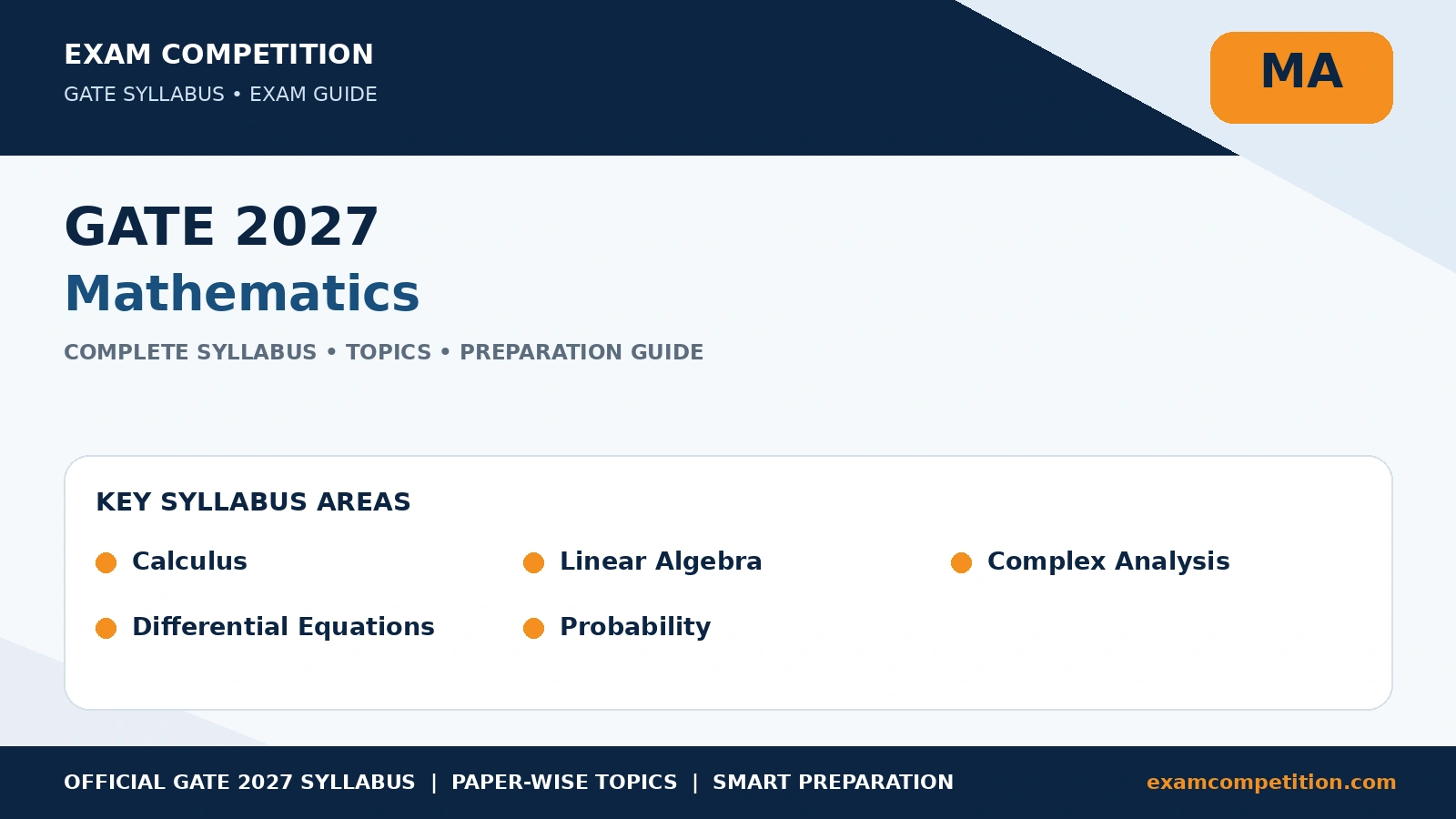
The GATE 2027 Mathematics (MA) paper covers a broad range of pure and applied mathematics topics. The official syllabus released by IIT Madras contains 11 sections, beginning with Calculus and Linear Algebra and extending to advanced areas such as Functional Analysis, Topology, Partial Differential Equations and Linear Programming.
Candidates preparing for the MA paper should build strong conceptual foundations and regularly practise proofs, calculations, numerical methods and problem-solving techniques across all the prescribed sections.
GATE 2027 MA Syllabus at a Glance
| Section | Major Topics |
|---|---|
| 1. Calculus | Multivariable calculus, multiple integrals and vector calculus |
| 2. Linear Algebra | Vector spaces, linear transformations, matrices, eigenvalues, diagonalization and quadratic forms |
| 3. Real Analysis | Metric spaces, continuity, convergence, measure, Lebesgue integration and Lp spaces |
| 4. Complex Analysis | Analytic functions, complex integration, power series, residues and conformal mappings |
| 5. Ordinary Differential Equations | First and higher-order ODEs, Laplace transforms, series solutions, special functions and stability |
| 6. Algebra | Groups, rings, fields, homomorphisms, Sylow theorems and field extensions |
| 7. Functional Analysis | Normed spaces, Banach spaces, Hilbert spaces, operators and major functional-analysis theorems |
| 8. Numerical Analysis | Numerical linear algebra, nonlinear equations, interpolation, integration and ODE methods |
| 9. Partial Differential Equations | First and second-order PDEs, characteristics, Laplace, heat and wave equations |
| 10. Topology | Topological spaces, connectedness, compactness, countability and separation axioms |
| 11. Linear Programming | Linear programming, simplex methods, duality, transportation and assignment problems |
Section 1: Calculus
The Calculus section focuses on functions of several variables, multiple integration and vector calculus.
| Topic | Detailed Syllabus |
|---|---|
| Multivariable Functions | Functions of two or more variables, continuity, directional derivatives, partial derivatives and total derivative |
| Taylor's Theorem | Taylor's theorem |
| Maxima and Minima | Maxima, minima and saddle points |
| Lagrange Multipliers | Method of Lagrange's multipliers |
| Multiple Integrals | Double and triple integrals |
| Jacobians | Jacobians and change of variables |
| Applications | Applications of multiple integrals to area, volume and surface area |
| Vector Calculus | Gradient, divergence and curl |
| Line and Surface Integrals | Line integrals and surface integrals |
| Integral Theorems | Green's theorem, Stokes' theorem and Gauss divergence theorem |
Section 2: Linear Algebra
Linear Algebra covers finite-dimensional vector spaces, linear transformations, matrix theory, inner-product spaces and canonical forms.
| Topic | Detailed Syllabus |
|---|---|
| Vector Spaces | Finite dimensional vector spaces over real or complex fields |
| Linear Transformations | Linear transformations and their matrix representations |
| Rank and Nullity | Rank and nullity |
| Linear Equations | Systems of linear equations |
| Eigenvalues and Eigenvectors | Characteristic polynomial, eigenvalues and eigenvectors |
| Diagonalization | Diagonalization and minimal polynomial |
| Cayley-Hamilton | Cayley-Hamilton theorem |
| Inner Product Spaces | Finite dimensional inner product spaces and Gram-Schmidt orthonormalization |
| Matrix Classes | Symmetric, skew-symmetric, Hermitian, skew-Hermitian, normal, orthogonal and unitary matrices |
| Canonical Forms | Diagonalization by a unitary matrix and Jordan canonical form |
| Forms | Bilinear and quadratic forms |
Section 3: Real Analysis
| Topic | Detailed Syllabus |
|---|---|
| Metric Spaces | Metric spaces, Baire category theorem, connectedness, compactness and completeness |
| Continuity | Continuity and uniform continuity of functions |
| Sequences and Series | Sequences and series of functions and uniform convergence |
| Ascoli-Arzela | Ascoli-Arzela theorem |
| Approximation | Weierstrass approximation theorem |
| Contraction Mapping | Contraction mapping principle |
| Power Series | Power series |
| Several Variables | Differentiation of functions of several variables |
| Function Theorems | Inverse and implicit function theorems |
| Lebesgue Theory | Lebesgue measure on the real line and measurable functions |
| Lebesgue Integration | Lebesgue integral, Fatou's lemma, monotone convergence theorem and dominated convergence theorem |
| Lp Spaces | Lp spaces |
Section 4: Complex Analysis
Complex Analysis includes analytic functions, complex integration, power series, singularities, residue theory and conformal mappings.
| Topic | Detailed Syllabus |
|---|---|
| Complex Functions | Functions of a complex variable, continuity, differentiability, analytic functions and harmonic functions |
| Complex Integration | Cauchy's integral theorem and Cauchy's integral formula |
| Major Theorems | Liouville's theorem, maximum modulus principle and Morera's theorem |
| Zeros and Singularities | Zeros and singularities |
| Power Series | Power series, radius of convergence, Taylor's series and Laurent's series |
| Residues | Residue theorem and applications for evaluating real integrals |
| Advanced Results | Rouche's theorem, argument principle and Schwarz lemma |
| Conformal Mapping | Conformal mappings and Mobius transformations |
Section 5: Ordinary Differential Equations
| Topic | Detailed Syllabus |
|---|---|
| First Order ODEs | First order ordinary differential equations |
| Existence and Uniqueness | Existence and uniqueness theorems for initial value problems |
| Higher Order ODEs | Linear ordinary differential equations of higher order with constant coefficients |
| Variable Coefficients | Second order linear ordinary differential equations with variable coefficients |
| Cauchy-Euler Equation | Cauchy-Euler equation |
| Laplace Transforms | Definition and basic properties of Laplace transforms and applications for solving ordinary differential equations |
| Series Solutions | Power series and Frobenius method |
| Special Functions | Legendre and Bessel functions and their orthogonal properties |
| Systems of ODEs | Systems of linear first order ordinary differential equations |
| Sturm-Liouville Theory | Sturm's oscillation and separation theorems and Sturm-Liouville eigenvalue problems |
| Planar Autonomous Systems | Stability of stationary points for linear systems with constant coefficients, linearized stability and Lyapunov functions |
Section 6: Algebra
| Area | Syllabus Topics |
|---|---|
| Groups | Groups, subgroups, normal subgroups, quotient groups, homomorphisms and automorphisms |
| Special Groups | Cyclic groups, permutation groups and group action |
| Finite Abelian Groups | Finite Abelian groups |
| Sylow Theorems | Sylow's theorems and their applications |
| Rings | Rings, ideals, prime and maximal ideals and quotient rings |
| Integral Domains | Unique factorization domains, principal ideal domains and Euclidean domains |
| Polynomial Rings | Polynomial rings and Eisenstein's irreducibility criterion |
| Fields | Fields, finite fields, field extensions, algebraic extensions and algebraically closed fields |
Section 7: Functional Analysis
| Topic | Detailed Syllabus |
|---|---|
| Normed Linear Spaces | Normed linear spaces |
| Linear Operators | Bounded linear operators and compact linear operators |
| Banach Spaces | Banach spaces and separability |
| Dual Spaces | Dual spaces |
| Hahn-Banach | Hahn-Banach theorem |
| Operator Theorems | Open mapping and closed graph theorems and principle of uniform boundedness |
| Inner Product Spaces | Inner-product spaces, Hilbert spaces and orthonormal bases |
| Projection | Projection theorem |
| Riesz Representation | Riesz representation theorem |
| Spectral Theory | Spectral theorem for compact self-adjoint operators |
Section 8: Numerical Analysis
Numerical Analysis covers numerical methods for linear systems, nonlinear equations, interpolation, differentiation, integration and ordinary differential equations.
| Area | Topics |
|---|---|
| Linear Systems | Gaussian elimination, LU decomposition and Cholesky factorization |
| Iterative Methods | Gauss-Seidel and Jacobi methods and their convergence for diagonally dominant coefficient matrices |
| Nonlinear Equations | Bisection, secant, Newton-Raphson and fixed-point iteration methods |
| Interpolation | Lagrange and Newton forms of interpolating polynomial and error in polynomial interpolation |
| Numerical Differentiation | Numerical differentiation and error |
| Numerical Integration | Trapezoidal and Simpson rules, Newton-Cotes integration formulas, composite rules and mathematical errors |
| ODE Numerical Methods | Euler method and Runge-Kutta method of order 2 for initial value problems |
Section 9: Partial Differential Equations
| Topic | Detailed Syllabus |
|---|---|
| Characteristics | Method of characteristics for first order linear and quasilinear partial differential equations |
| Second Order PDEs | Classification and canonical forms of second order partial differential equations in two independent variables |
| Laplace Equation | Method of separation of variables for Laplace equation in Cartesian and polar coordinates |
| Maximum Principle | Maximum principle |
| Heat Equation | Heat equation in one space variable and its Cauchy problem |
| Wave Equation | Wave equation in one space variable, Cauchy problem, d'Alembert formula, domains of dependence and influence, and non-homogeneous wave equation |
| Transform Methods | Laplace and Fourier transform methods |
Section 10: Topology
The Topology section covers fundamental concepts of topological spaces together with connectedness, compactness and separation properties.
| Topic | Detailed Syllabus |
|---|---|
| Topological Spaces | Basic concepts of topology, bases, subbases and subspace topology |
| Special Topologies | Order topology, product topology, quotient topology and metric topology |
| Connectedness | Connectedness and path connectedness |
| Compactness | Compactness, sequentially compact spaces and limit point compactness |
| Tychonoff Theorem | Tychonoff theorem |
| Countability | Countability axioms |
| Separation | Separation axioms |
| Extension Theorems | Urysohn's Lemma and Tietze extension theorem |
Section 11: Linear Programming
Linear Programming covers mathematical models, convexity, simplex methods, duality, transportation problems and assignment problems.
| Area | Syllabus Topics |
|---|---|
| Linear Programming Models | Linear programming models, convex sets and extreme points |
| Basic Feasible Solution | Basic feasible solution and graphical method |
| Simplex Methods | Simplex method, two phase methods and revised simplex method |
| Special Models | Infeasible and unbounded linear programming models and alternate optima |
| Duality | Duality theory, weak duality and strong duality |
| Transportation Problems | Balanced and unbalanced transportation problems |
| Initial Basic Feasible Solution | Least cost method, north-west corner rule and Vogel's approximation method |
| Optimal Transportation Solution | Optimal solution and modified distribution method |
| Assignment Problems | Solving assignment problems using the Hungarian method |
Important GATE 2027 MA Topics for Preparation
| Preparation Area | Important Focus |
|---|---|
| Calculus | Multivariable differentiation, multiple integrals, Jacobians, vector calculus and integral theorems |
| Linear Algebra | Vector spaces, linear transformations, eigenvalues, diagonalization, inner-product spaces and canonical forms |
| Real Analysis | Metric spaces, convergence, compactness, measure theory and Lebesgue integration |
| Complex Analysis | Analytic functions, Cauchy theory, Laurent series, residues and conformal mappings |
| ODE | Existence and uniqueness, Laplace transforms, series solutions, special functions and stability |
| Algebra | Groups, rings, ideals, fields, Sylow theorems and field extensions |
| Functional Analysis | Banach and Hilbert spaces, operators, Hahn-Banach theorem and spectral theorem |
| Numerical Analysis | Linear systems, nonlinear equations, interpolation, numerical integration and ODE methods |
| PDE | Characteristics, classification, Laplace, heat and wave equations and transform methods |
| Topology | Topological spaces, connectedness, compactness and separation axioms |
| Linear Programming | Simplex methods, duality, transportation problems and assignment problems |
GATE 2027 MA Paper Pattern
According to the official GATE 2027 question paper pattern, the Mathematics paper carries 100 marks. General Aptitude accounts for 15 marks and the Mathematics subject section accounts for 85 marks. The total examination duration is 180 minutes.
| Part | Marks |
|---|---|
| General Aptitude | 15 |
| Mathematics | 85 |
| Total | 100 |
| Duration | 180 minutes |
How to Prepare for GATE Mathematics 2027
GATE MA preparation should begin with the core mathematical concepts that support multiple sections. Linear Algebra, Calculus and Analysis provide a strong foundation for several advanced topics, while ODE, PDE and Numerical Analysis require consistent problem-solving practice.
Candidates should also allocate dedicated study time to Algebra, Functional Analysis and Topology because these sections contain theorem-based concepts that require careful understanding rather than only formula-based preparation.
For Numerical Analysis and Linear Programming, candidates should practise complete problems using the prescribed numerical and optimization methods. Regular revision of definitions, theorems and standard techniques can help improve accuracy during the examination.
GATE 2027 MA Syllabus PDF
Candidates should use the official IIT Madras Mathematics syllabus as the primary reference for GATE 2027 MA preparation. The official syllabus contains all 11 sections and their prescribed topics.
Download GATE 2027 MA Syllabus PDF
Frequently Asked Questions
What is the GATE 2027 MA paper?
How many sections are there in the GATE Mathematics syllabus?
Is Real Analysis included in GATE MA?
Does GATE Mathematics include Functional Analysis?
Is Topology included in the GATE MA syllabus?
Is Linear Programming part of GATE Mathematics?
Source: IIT Madras