UPSC Principal 2022 Question Paper Analysis: Subject-Wise and Topic-Wise Weightage
UPSC Principal 2022 Question Paper Analysis
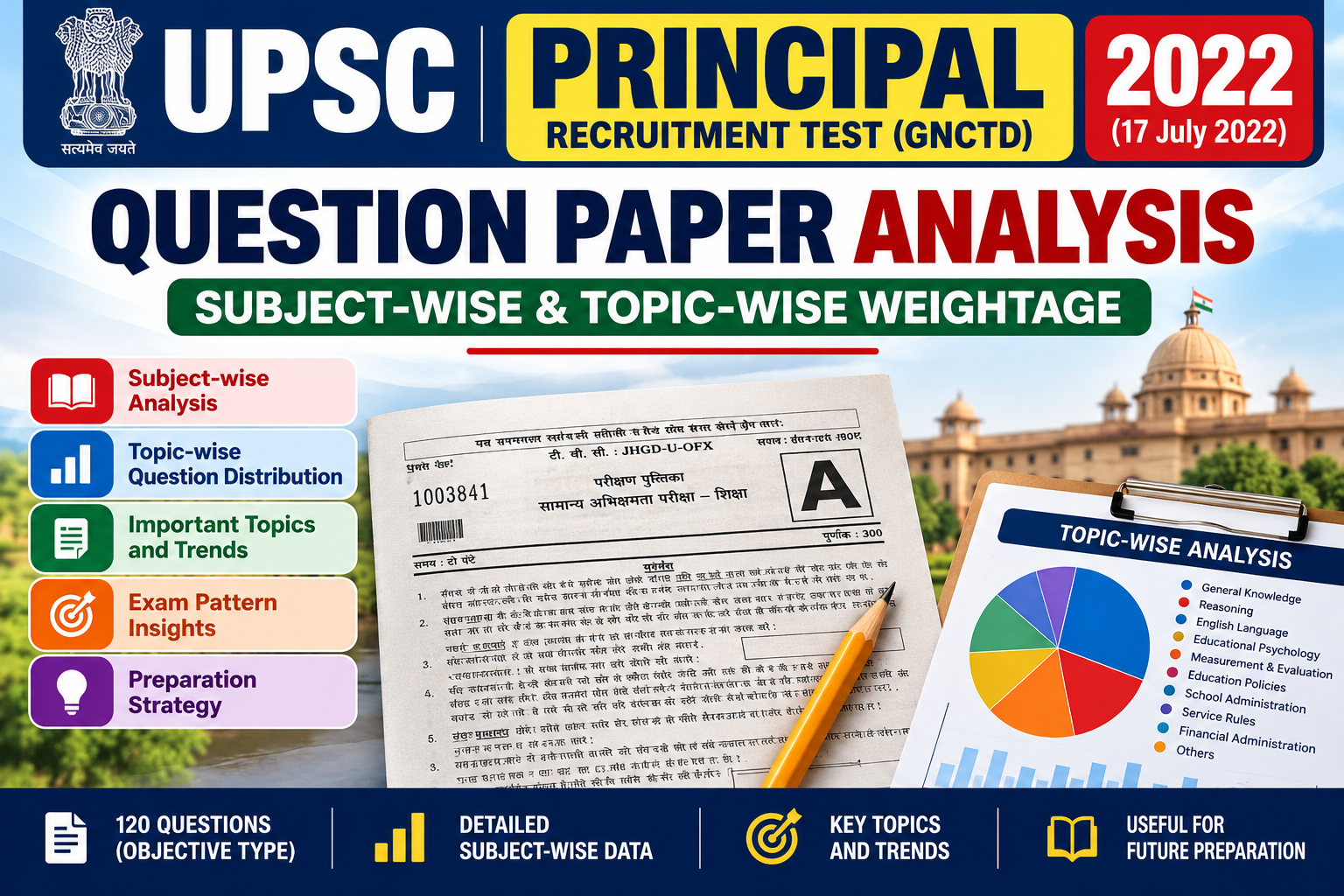
The UPSC Principal Recruitment Test for GNCTD was held on 17 July 2022. The question paper contains 120 objective-type questions and carries 300 marks. This article organises the paper into broad subject areas to help candidates understand the topics covered and plan their preparation.
1. Subject-Wise Question Distribution
The following table provides a preliminary overview of the paper. The question counts are based on grouped question-number ranges, not a completed question-by-question audit.
| Subject Area | Question Numbers | Indicative Questions | Indicative Share |
|---|---|---|---|
| General Knowledge and Current Affairs | 1-12 | 12 | 10.00% |
| Reasoning and Quantitative Aptitude | 13-20 | 8 | 6.67% |
| English Language | 21-28 | 8 | 6.67% |
| Educational Psychology and Related Concepts | 29-45 | 17 | 14.17% |
| Measurement, Evaluation, Statistics and Research Methods | 46-65 | 20 | 16.67% |
| Education, Curriculum and Educational Policy | 66-86 | 21 | 17.50% |
| School Standards, Safety and Child-Rights Provisions | 87-95 | 9 | 7.50% |
| Government Administration, Service Rules and Financial/Procurement Rules | 96-120 | 25 | 20.83% |
| Total | 1-120 | 120 | 100% |
2. Topic-Wise Coverage
General Knowledge and Current Affairs
- Government initiatives and online portals, including DESH-Stack.
- Agriculture and Minimum Support Price (MSP).
- PM-KISAN scheme and its provisions.
- National parks and wildlife conservation.
- Indian musical instruments, textiles and cultural traditions.
- Cryptocurrency and related issues in India.
- International investment and economic developments.
Reasoning and Quantitative Aptitude
- Logical statements and conclusions.
- Family relationships.
- Analogy and classification.
- Set relationships and Venn-diagram reasoning.
- Geometry and circles.
- Ranking and position-based problems.
- Work-rate and pump problems.
- Numerical calculations and changes in production cost.
English Language
- Grammar and sentence correction.
- Subject-verb agreement and correct usage.
- Vocabulary and word meaning.
- Idioms and expressions.
- Reading comprehension.
- Contextual vocabulary, including words used in passages.
Educational Psychology and Related Concepts
- Learning and learner-related concepts.
- Student assessment and identification of learning difficulties.
- Psychological and educational testing concepts.
- Achievement, aptitude and diagnostic testing.
- Concepts related to the interpretation of learner performance.
Measurement, Evaluation, Statistics and Research Methods
- Parametric and non-parametric tests.
- Assumptions of parametric tests.
- Probability and non-probability sampling.
- Normal distribution and standard scores.
- Validity, reliability and psychological testing.
- Attitude scales and personality assessment.
- Continuous and discrete variables.
- Qualitative research approaches.
- Norm-referenced and criterion-referenced testing.
- Achievement-test principles and interview methods.
Education, Curriculum and Educational Policy
- Ancient educational institutions of India.
- National Curriculum Framework (NCF) 2005.
- Right of Children to Free and Compulsory Education Act, 2009.
- School infrastructure requirements.
- National Education Policy 2020.
- School governance and school-complex recommendations.
- School standards and quality assurance.
- Educational development and participation across states.
School Standards, Safety and Child-Rights Provisions
- State School Standards Authority.
- School Safety Policy 2016.
- School infrastructure hazards and safety responsibilities.
- School disaster management plans and committees.
- Commissions for Protection of Child Rights Act, 2005.
- National and State Commissions for Protection of Child Rights.
- School governance and child-protection provisions.
Government Administration, Service Rules and Financial/Procurement Rules
- Government service conduct and disciplinary rules.
- Central Civil Services (Classification, Control and Appeal) Rules, 1965.
- Leave rules, including casual leave.
- Service books and retention periods.
- Right to Information Act, 2005.
- Official Language policy and use of Hindi.
- Government e-Marketplace (GeM).
- Limited Tender Enquiry and procurement procedures.
- General Financial Rules, 2017.
- Performance security, price variation and capital expenditure.
- Earnest Money Deposit (EMD) requirements.
- Government servants and outside activities.
- Child-protection and workplace sexual-harassment legislation.
3. Important Topics for Preparation
Based on the topics identifiable in the scanned paper, candidates preparing for a similar Principal recruitment examination should give attention to the following areas:
- Educational policy and legislation: NCF 2005, NEP 2020, the RTE Act 2009 and child-rights legislation.
- Educational measurement and research: validity, reliability, sampling, standard scores, tests and research approaches.
- School safety and governance: School Safety Policy 2016, disaster management and school standards.
- Government service rules: leave, disciplinary rules, service records and conduct requirements.
- Financial and procurement rules: GFR 2017, GeM, tendering, EMD and performance security.
- General awareness: government schemes, culture, environment and economic developments.
- English and reasoning: grammar, comprehension, idioms, logical reasoning and numerical aptitude.
4. How to Use This Analysis
Use the listed subjects and topics as a revision checklist rather than as a confirmed prediction of future question weightage. Read the relevant laws, policies and rules in their applicable official versions, practise objective questions, and revise concepts that require interpretation rather than memorisation alone.
5. Source and Accuracy Statement
This overview is based on the scanned UPSC Principal Recruitment Test question paper dated 17 July 2022. OCR can misread text, and grouping questions by number alone does not establish a verified subject-wise count. The subject totals and percentages shown above are provisional. A definitive topic-wise weightage table requires manual verification of each question against the original paper.
0 Comments
No comments yet — be the first to share your thoughts.