DSSSB TGT Computer Science Chapter-Wise Weightage: 5 Previous Year Papers Analysed
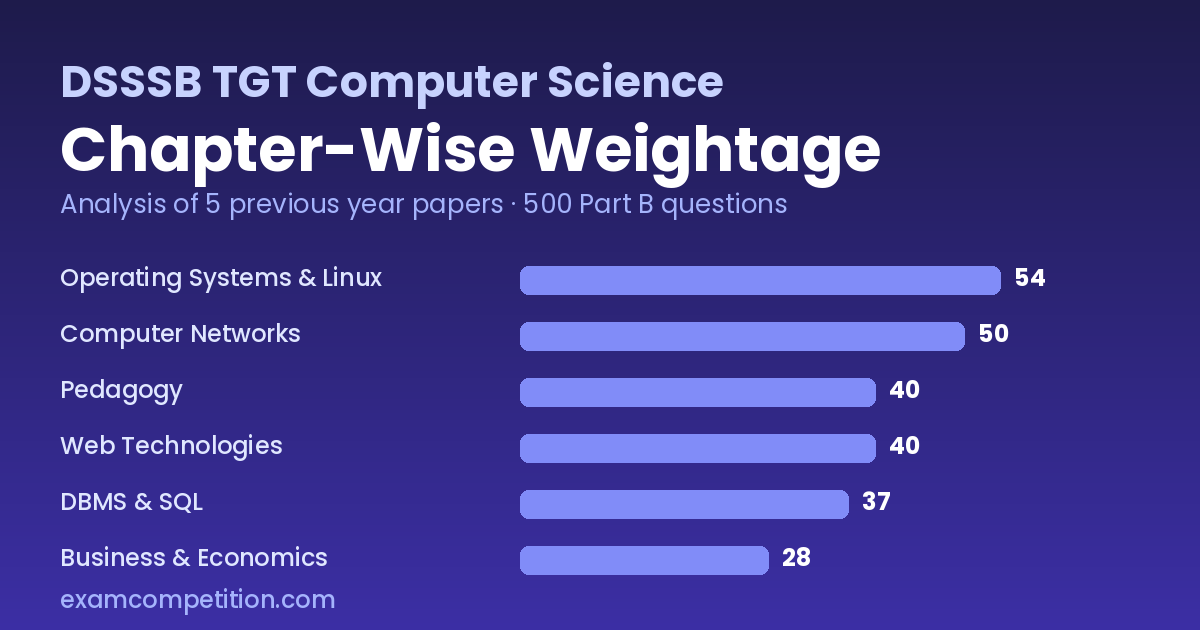
Which chapters should you study first for the DSSSB TGT Computer Science exam? We went through five previous-year papers (2017, 2023 and 2024), tagged every one of the 500 Part B questions to a chapter, and counted. This is the chapter-wise weightage that came out of it.
Papers analysed
All five papers are 200-question tests (Part A general section plus Part B subject section). Only Part B, the 100 subject questions in each paper, is counted below.
| # | Paper (held on) | Questions | Structure |
|---|---|---|---|
| 1 | 21 May 2017 | 200 | 100 (Part A) + 100 (Part B) |
| 2 | 24 June 2023 (Shift 3) | 200 | 100 (Part A) + 100 (Part B) |
| 3 | 25 June 2023 (Shift 1) | 200 | 100 (Part A) + 100 (Part B) |
| 4 | 25 June 2023 (Shift 2) | 200 | 100 (Part A) + 100 (Part B) |
| 5 | 7 February 2024 (Shift 2) | 200 | 100 (Part A) + 100 (Part B) |
DSSSB TGT Computer Science chapter-wise weightage (overall)
The table is sorted from the most asked to the least asked chapter. “% of core CS” leaves out the non-Computer Science questions (mathematics, business, physics and pedagogy) so that you can see how the Computer Science syllabus alone is split.
| # | Chapter / topic area | Questions (5 papers) | Avg. per paper | % of Part B | % of core CS | Weightage |
|---|---|---|---|---|---|---|
| 1 | Operating Systems & Linux | 54 | 10.8 | 10.8% | 13.6% | |
| 2 | Computer Networks & Mobile Computing | 50 | 10.0 | 10.0% | 12.6% | |
| 3 | Pedagogy & Child Development non-CS | 40 | 8.0 | 8.0% | – | |
| 4 | Web Technologies (HTML, CSS, XML, .NET) | 40 | 8.0 | 8.0% | 10.1% | |
| 5 | DBMS & SQL | 37 | 7.4 | 7.4% | 9.3% | |
| 6 | Business, Economics & Accounting non-CS | 28 | 5.6 | 5.6% | – | |
| 7 | Mathematics, Statistics & Numerical Methods non-CS | 26 | 5.2 | 5.2% | – | |
| 8 | Computer Organization & Architecture | 24 | 4.8 | 4.8% | 6.0% | |
| 9 | Digital Logic & Number Systems | 23 | 4.6 | 4.6% | 5.8% | |
| 10 | C Programming | 21 | 4.2 | 4.2% | 5.3% | |
| 11 | MIS, Knowledge Management & E-commerce | 19 | 3.8 | 3.8% | 4.8% | |
| 12 | Python & Pandas | 17 | 3.4 | 3.4% | 4.3% | |
| 13 | Software Engineering | 17 | 3.4 | 3.4% | 4.3% | |
| 14 | Cyber Security, IPR & E-waste | 16 | 3.2 | 3.2% | 4.0% | |
| 15 | Algorithms, Complexity & Flowcharts | 14 | 2.8 | 2.8% | 3.5% | |
| 16 | C++ & Object-Oriented Programming | 12 | 2.4 | 2.4% | 3.0% | |
| 17 | Computer Graphics & Multimedia | 11 | 2.2 | 2.2% | 2.8% | |
| 18 | Java Programming | 11 | 2.2 | 2.2% | 2.8% | |
| 19 | Computer Fundamentals & MS Office | 10 | 2.0 | 2.0% | 2.5% | |
| 20 | Data Structures | 9 | 1.8 | 1.8% | 2.3% | |
| 21 | Physics & Electronics non-CS | 9 | 1.8 | 1.8% | – | |
| 22 | AI, ML, Data Science & IoT | 6 | 1.2 | 1.2% | 1.5% | |
| 23 | Compilers & System Software | 6 | 1.2 | 1.2% | 1.5% | |
| Total Part B questions analysed | 500 | 100 | 100% | 397 core CS |
Year-wise chapter weightage
The same questions, split by paper. A dash means no question from that chapter in that paper.
| Chapter | 2017 | Jun 2023 S3 | Jun 2023 S1 | Jun 2023 S2 | Feb 2024 | Total |
|---|---|---|---|---|---|---|
| Operating Systems & Linux | 22 | 9 | 6 | 7 | 10 | 54 |
| Computer Networks & Mobile Computing | 15 | 6 | 12 | 10 | 7 | 50 |
| Pedagogy & Child Development | – | 10 | 10 | 10 | 10 | 40 |
| Web Technologies (HTML, CSS, XML, .NET) | 7 | 12 | 11 | 4 | 6 | 40 |
| DBMS & SQL | 12 | 3 | 2 | 5 | 15 | 37 |
| Business, Economics & Accounting | – | 9 | 8 | 11 | – | 28 |
| Mathematics, Statistics & Numerical Methods | – | 8 | 8 | 10 | – | 26 |
| Computer Organization & Architecture | 5 | 4 | 2 | 5 | 8 | 24 |
| Digital Logic & Number Systems | 4 | 6 | 3 | 3 | 7 | 23 |
| C Programming | 10 | – | 5 | 3 | 3 | 21 |
| MIS, Knowledge Management & E-commerce | – | 7 | 8 | 4 | – | 19 |
| Python & Pandas | – | – | – | – | 17 | 17 |
| Software Engineering | 3 | 5 | 5 | 4 | – | 17 |
| Cyber Security, IPR & E-waste | – | 1 | 2 | 3 | 10 | 16 |
| Algorithms, Complexity & Flowcharts | 2 | 5 | 4 | 3 | – | 14 |
| C++ & Object-Oriented Programming | 6 | 1 | 2 | 3 | – | 12 |
| Computer Graphics & Multimedia | 3 | 2 | 3 | 3 | – | 11 |
| Java Programming | 2 | 5 | 3 | 1 | – | 11 |
| Computer Fundamentals & MS Office | 5 | – | 1 | 4 | – | 10 |
| Data Structures | 4 | 2 | 2 | 1 | – | 9 |
| Physics & Electronics | – | 3 | 2 | 4 | – | 9 |
| AI, ML, Data Science & IoT | – | – | 1 | – | 5 | 6 |
| Compilers & System Software | – | 2 | – | 2 | 2 | 6 |
| Total | 100 | 100 | 100 | 100 | 100 | 500 |
What the papers show
- Operating Systems and Linux never go away. 54 questions in five papers, and the 2017 paper alone had 22. Process management, deadlock, semaphores, memory management and Linux commands and permissions keep coming back.
- Networking is steady. 50 questions, with every paper asking at least 6. TCP/IP and OSI layers, IP addressing and subnetting, and the data link and transport layers are the usual targets.
- The pattern of Part B changed in 2023. The 2017 paper had 100 Computer Science questions. In the three 2023 papers roughly two-thirds of Part B was Computer Science, and the rest was mathematics, business and economics, physics and electronics, plus 10 pedagogy questions in each paper.
- The February 2024 paper moved to newer topics. It had no business or maths section, but 17 Python and Pandas questions, 15 on DBMS and SQL and 10 on cyber security, IPR and e-waste.
Most asked chapters in the latest paper (7 February 2024, Shift 2)
- Python & Pandas: 17 questions
- DBMS & SQL: 15 questions
- Operating Systems & Linux: 10 questions
- Cyber Security, IPR & E-waste: 10 questions
- Computer Organization & Architecture: 8 questions
- Computer Networks & Mobile Computing: 7 questions
- Digital Logic & Number Systems: 7 questions
- Web Technologies (HTML, CSS, XML, .NET): 6 questions
How to prioritise your preparation
High priority (35+ questions)
- Operating Systems & Linux – 54 questions (10.8%)
- Computer Networks & Mobile Computing – 50 questions (10.0%)
- Pedagogy & Child Development – 40 questions (8.0%)
- Web Technologies (HTML, CSS, XML, .NET) – 40 questions (8.0%)
- DBMS & SQL – 37 questions (7.4%)
Medium priority (15–34 questions)
- Business, Economics & Accounting – 28 questions (5.6%)
- Mathematics, Statistics & Numerical Methods – 26 questions (5.2%)
- Computer Organization & Architecture – 24 questions (4.8%)
- Digital Logic & Number Systems – 23 questions (4.6%)
- C Programming – 21 questions (4.2%)
- MIS, Knowledge Management & E-commerce – 19 questions (3.8%)
- Python & Pandas – 17 questions (3.4%)
- Software Engineering – 17 questions (3.4%)
- Cyber Security, IPR & E-waste – 16 questions (3.2%)
Lower priority (under 15 questions)
- Algorithms, Complexity & Flowcharts – 14 questions (2.8%)
- C++ & Object-Oriented Programming – 12 questions (2.4%)
- Computer Graphics & Multimedia – 11 questions (2.2%)
- Java Programming – 11 questions (2.2%)
- Computer Fundamentals & MS Office – 10 questions (2.0%)
- Data Structures – 9 questions (1.8%)
- Physics & Electronics – 9 questions (1.8%)
- AI, ML, Data Science & IoT – 6 questions (1.2%)
- Compilers & System Software – 6 questions (1.2%)
Study plan from the weightage
- Weeks 1–2: Operating Systems & Linux and Computer Networks. Solve every previous-year question on these two first.
- Weeks 3–4: DBMS & SQL, Web Technologies and Python. Practise SQL queries and HTML/CSS tags by writing them, not just reading.
- Week 5: Computer Organization, Digital Logic and Number Systems, then C and C++ output-based questions.
- Week 6: Software Engineering, MIS and E-commerce, Cyber Security and IPR, then Pedagogy.
- Final weeks: Attempt full papers under the 120-minute limit and review the chapters where you lose marks.
Practise these papers online
Attempt the same papers as free full-length tests, with question-wise solutions and a rank after you submit:
- DSSSB TGT Computer Science Previous Year Papers – practice tests
- DSSSB TGT Computer Science free mock tests
- DSSSB TGT Computer Science notes
- DSSSB TGT Computer Science exam page
How we counted
We used the 500 Part B questions of the five papers listed above. Each question was tagged to one chapter by its topic, for example a question on chmod counts under Operating Systems & Linux and a question on the TCP congestion window counts under Computer Networks. Questions that sit between two chapters were placed where a teacher would normally teach them. Part A (general awareness, reasoning, arithmetic, Hindi and English) is not included. These figures come from the papers as they appear in our practice tests and are not an official DSSSB breakup. The next paper can differ.
Frequently asked questions
Which chapter has the highest weightage in DSSSB TGT Computer Science?
In the five previous-year papers we analysed (2017, 2023 and 2024), Operating Systems & Linux was the most asked chapter with 54 of 500 Part B questions (10.8%), followed by Computer Networks & Mobile Computing with 50 (10.0%).
How many questions are asked from Computer Science in DSSSB TGT?
Each paper has 200 questions: Part A (100 questions of general awareness, reasoning, arithmetic, Hindi and English, 20 each) and Part B (100 questions on the subject). Part B also carries pedagogy questions in the 2023 and 2024 papers we analysed.
Is Python asked in DSSSB TGT Computer Science?
Yes. The 7 February 2024 (Shift 2) paper had 17 Python and Pandas questions, while the 2017 and 2023 papers had none. Python should be part of your preparation for the next cycle.
Are non-Computer Science questions asked in Part B?
In the three 2023 papers Part B included questions on mathematics and numerical methods, business and economics, physics and electronics, plus 10 pedagogy questions in each. The 2017 paper had no such questions, and the February 2024 paper was Computer Science plus 10 pedagogy questions.
How was this chapter-wise weightage calculated?
We took all 500 Part B questions from five previous-year papers, tagged each question to one chapter by its topic, and counted. Some questions sit between two chapters (for example, file permissions can be filed under Operating Systems or Linux), so treat the figures as a reliable guide rather than an official breakup.
Where can I practise these previous-year papers?
You can attempt all five papers as free full-length tests on ExamCompetition and see your rank and question-wise solutions after submitting.
Prepared by the ExamCompetition team from five DSSSB TGT Computer Science previous-year papers. Check the official DSSSB website for the latest syllabus and notifications.
Source: ExamCompetition
0 Comments
No comments yet — be the first to share your thoughts.